She Heard Her Husband in the Hospital Hallway. Then She Turned Back……
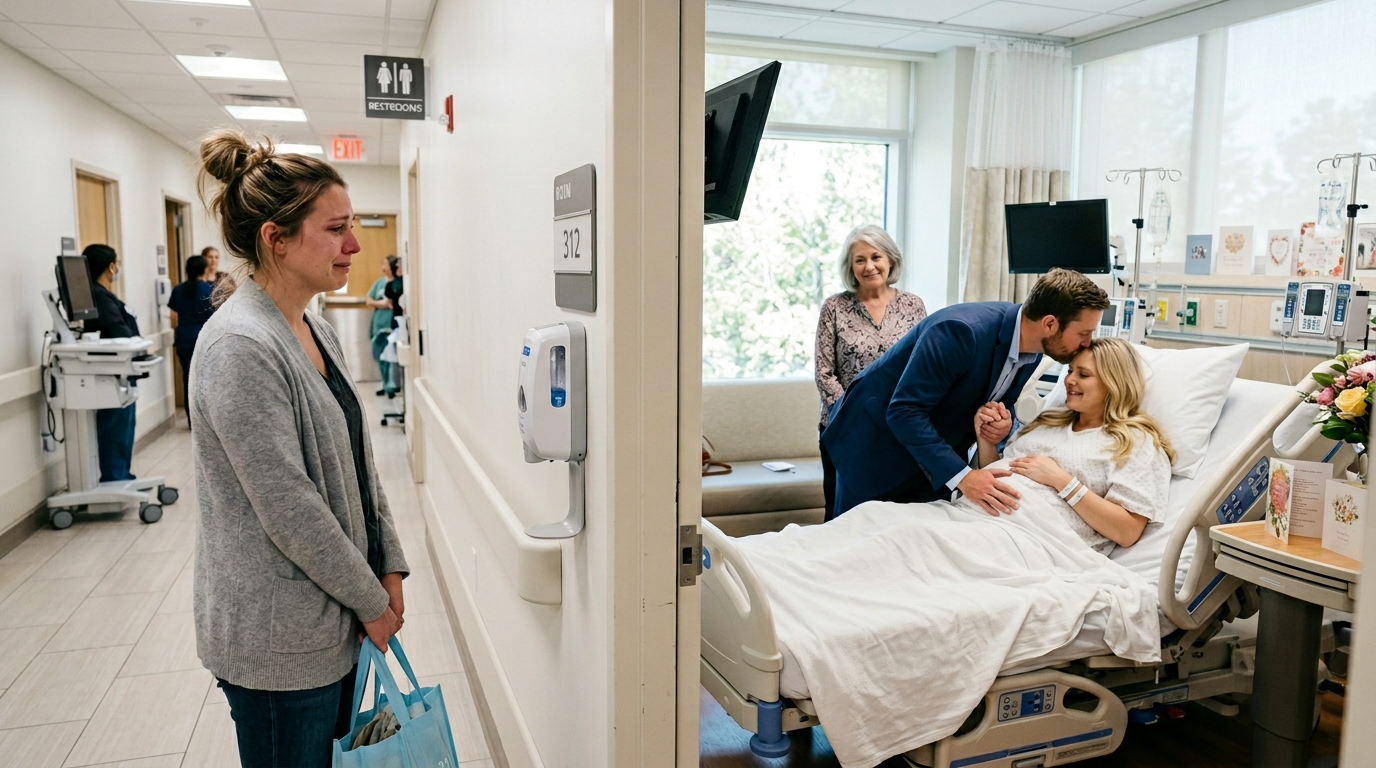
I never thought my sister giving birth would be the moment my life split cleanly in half.
For weeks, I had told myself to be generous.
Sierra was scared.
Sierra was tired.
Sierra was my sister, even if we had spent most of our lives standing on opposite sides of our mother’s affection like two women waiting for the same door to open.
Our mother had always made loving us feel like a competition.
Sierra got softness.
I got expectations.
Sierra got excuses.
I got lectures.
When Sierra was late on rent, there was always a reason.
When I cried because Kevin and I were bleeding money into fertility treatments, there was always a lesson about patience, gratitude, and not making everything about myself.
I used to think that was just how families worked.
Someone always got carried.
Someone always did the carrying.
Kevin knew that about me.
He knew I was the one who remembered birthdays, paid bills before reminders turned red, sent grocery money without asking for receipts, and stayed calm because everybody else had already claimed the right to fall apart.
He had married that part of me.
Or maybe he had just learned how to use it.
The morning Sierra gave birth, I woke up before my alarm.
It was still gray outside, the kind of early light that makes a bedroom look colder than it is.
Kevin was already gone.
He had told me the night before that he had an early meeting, some client emergency, some work problem that required him to leave before sunrise.
I believed him because marriage teaches you to believe small lies long before you recognize large ones.
I showered, dried my hair, and stood in the kitchen writing Sierra’s card again.
The first version sounded too stiff.
The second sounded too emotional.
The third version said, “Welcome to the world, little one. You are already loved.”
I stared at that sentence for a while.
Then I signed my name.
Not Kevin’s.
Mine.
On the passenger seat of my car sat a pastel gift bag with white tissue paper folded over the top.
Inside was a soft blue blanket, a rabbit rattle, and the card I had rewritten three times because I wanted to be better than the history between us.
It seems ridiculous now, how much tenderness I packed into that bag.
But at the time, I thought showing up mattered.
I thought love could be proven by effort.
The drive to Lakeside Medical Center took twenty-three minutes.
I remember that because the navigation screen said twenty-three, and I thought about how many times I had driven that same route for fertility appointments with Kevin sitting beside me in silence.
We had parked in the same garage.
We had walked through the same glass doors.
We had waited in rooms that smelled like antiseptic and printer paper while nurses called other women’s names and I tried not to look at baby photos pinned to the clinic wall.
Kevin used to hold my hand in those rooms.
Not tightly.
Just enough that I could convince myself we were suffering together.
That morning, I parked alone.
The hospital lobby was bright and busy.
A volunteer at the front desk pointed me toward the maternity elevators.
There were flower arrangements on almost every counter, huge pink and yellow bursts wrapped in cellophane.
The air smelled like hand sanitizer, burnt coffee, and lilies that were too sweet.
A man near the gift shop was carrying balloons shaped like stars.
A woman in scrubs laughed softly into her phone.
Somewhere upstairs, someone had just become a father.
I stepped into the elevator holding the gift bag against my side.
The paper handles pressed into my palm.
I remember checking my reflection in the metal doors and thinking I looked tired but kind.
Tired was normal.
Kind was the goal.
The maternity floor was quieter than the lobby.
Nurses moved with that particular hospital calm, fast without seeming rushed.
A baby cried down the hallway, thin and new and furious.
For a moment, I smiled.
The whole floor felt suspended inside something fragile.
Pain had happened here, but so had arrival.
Fear had happened here, but so had joy.
I thought about Sierra in a hospital bed, exhausted and emotional, and I decided I would not bring our old tension into that room.
I would hug her.
I would congratulate her.
I would mean it as much as I could.
Then I heard Kevin.
At first, my brain did not accept it as Kevin’s voice.
It was too unexpected.
It came from Sierra’s room, low and smug, the exact tone he used when he thought he had already won an argument no one else knew they were having.
“She has no idea,” he said.
I stopped walking.
My shoe made a soft rubber sound against the polished floor.
The gift bag swung once against my thigh.
Then Kevin continued.
“At least she is useful as a source of money.”
The hallway did not change.
That was the strangest part.
The lights stayed bright.
The nurses kept moving.
A cart rolled somewhere behind me with a squeak in one wheel.
The world did not crack open just because mine did.
For one second, I honestly could not understand the sentence.
She.
Useful.
Money.
My body knew before my mind did.
My chest tightened so fast it felt like someone had reached inside me and closed a fist.
My fingers locked around the paper handles of the gift bag until the edges bit into my skin.
Then my mother spoke.
Her voice was calm.
That was worse than anger would have been.
Anger might have meant surprise.
Anger might have meant shame.
But she sounded practical, like she was discussing where to put a vase.
“You both deserve happiness,” she said.
There was a tiny pause.
Then she added, “She is just a worthless failure.”
I did not move.
I did not breathe.
I stood in a hospital hallway with a baby gift in my hand while my mother named me the way she had always seen me.
Not daughter.
Not wife.
Not person.
Failure.
And then Sierra laughed.
I will never forget that laugh.
It was not nervous.
It was not guilty.
It was delighted, light, almost girlish.
“Thanks,” she said. “I’ll make sure we are happy.”
I moved closer to the door without deciding to.
It was cracked open just enough for sound to travel.
Inside, I could hear the soft rustle of bedding.
A monitor beeped steadily.
Someone shifted in a chair.
My heartbeat was so loud in my ears that I thought I might miss the next words, but I heard them clearly.
Kevin said, “The baby looks just like me. We do not even need a DNA test.”
That was the moment the past began rearranging itself.
Not slowly.
All at once.
Kevin’s late nights at work.
The way his phone always faced down.
The sudden password change he explained as “security.”
Sierra calling me in tears about rent, groceries, medical bills, prenatal vitamins, unexpected costs.
My mother telling me I was cruel if I asked questions.
The missing money.
The exhausted kisses.
The fertility appointments where Kevin held my hand while apparently building a family in the next room of my life.
I had been grieving infertility while he celebrated paternity somewhere else.
I had been paying for more than my marriage.
I had been financing their betrayal.
There are moments when grief does not feel like sadness.
It feels like evidence.
Every small thing I had dismissed returned with a timestamp.
Every excuse stood up and confessed.
My hand slid into my coat pocket because I needed something solid to hold.
That was when I saw my phone screen.
It was lit.
The voice recorder was open.
In the confusion, when I first heard Kevin’s voice, my thumb must have tapped it.
The red line was still moving.
10:42 a.m.
Recording active.
I stared at that red line like it was the only honest thing left in the world.
Maybe it had not caught every word.
Maybe a nurse’s cart had rolled over part of it.
Maybe the hallway noise had blurred the beginning.
But the recorder had been running while Kevin spoke.
It had been running while my mother dismissed me.
It had been running while Sierra laughed.
My fingers shook.
For a second, I thought I might drop the phone, and if it shattered on the hospital floor, I would shatter with it.
So I closed my hand around it and stepped backward.
One step.
Then another.
I did not push the door open.
I did not scream.
I did not throw the gift bag into the room, though some part of me wanted to watch the soft blue blanket land at Kevin’s feet like an accusation.
I walked away.
That was the first decision I made as a woman no longer confused.
The family lounge at the end of the corridor was empty.
There was a sofa upholstered in gray fabric, a low table with old magazines, a vending machine humming in the corner, and a television mounted on the wall with the sound off.
I shut the door behind me.
Then my knees nearly gave out.
I sat down hard, still gripping the gift bag.
The tissue paper had crumpled.
The rabbit rattle inside made one tiny sound when it shifted, cheerful and obscene.
I looked at the recording.
I listened once.
Only once.
Kevin’s voice came through first, muffled but clear enough.
Then my mother.
Then Sierra.
Then the sentence about the baby.
By the time the recording ended, my face was wet, but I did not remember starting to cry.
I wiped my cheeks with the heel of my hand.
My reflection in the dark television screen looked like a stranger.
Red eyes.
Pale mouth.
Gift bag at her feet.
Phone in her hand.
I had spent years being told I was too emotional.
Too suspicious.
Too sensitive.
Too much.
Now I had proof that the only thing wrong with my instincts was that I had kept apologizing for them.
At 10:51 a.m., I called my bank.
My voice sounded strange.
Flat.
The woman on the line asked a series of verification questions, and I answered every one.
Mother’s maiden name.
Last four digits.
Security phrase.
Then I told her I needed to remove my husband’s access from every card and account in my name.
She paused for half a second.
Not long enough to be unprofessional.
Long enough to understand.
We went through card by card.
Login by login.
Authorized user by authorized user.
At 10:58 a.m., I changed my online passwords.
I changed the security questions Kevin knew because once, years earlier, we had sat at our kitchen table laughing while setting them up together.
First pet.
Favorite teacher.
Street you grew up on.
Trust is strange that way.
You hand someone the answers that protect you, and only later realize you also handed them the map.
At 11:07 a.m., I called the lawyer whose number I had saved months before.
Her name was Maren.
I had found her after a night when Kevin came home smelling like unfamiliar perfume and told me I was humiliating myself by asking where he had been.
I had not called then.
I had saved the contact under “M.”
Just that.
A letter hidden among other letters.
When Maren answered, I told her I had a recording.
I told her my husband had likely fathered my sister’s baby.
I told her money from my accounts had been going to my sister under false pretenses.
I told her I was still inside Lakeside Medical Center.
Maren did not gasp.
She did not ask me whether I was sure.
She asked, “Are you safe right now?”
That was the first kind question anyone had asked me that morning.
“Yes,” I said.
“Good,” she said. “Do not confront them alone unless you can remain calm. Do not threaten. Do not touch anyone. Do not give them your phone. Send me the recording immediately.”
So I did.
Then I sent screenshots of transfers I still had in my banking app.
Sierra emergency.
Rent help.
Medical bill.
Groceries.
Each label looked different now.
Each one had been a small door.
They had walked through all of them.
Maren told me to wait where I was.
I made one more call after that.
The details of that call mattered less than the act of making it.
I had spent years protecting other people from consequences.
That morning, I stopped.
By the time I stood, my hands were steady.
Not because I was no longer hurt.
I was hurt in places I did not have names for yet.
But steadiness is not the absence of pain.
Sometimes steadiness is what happens when pain finally points in the right direction.
I picked up the gift bag.
The paper handles had left red marks across my palm.
I smoothed the tissue paper once, an absurd little gesture, then walked back into the corridor.
Every step felt both too slow and too fast.
A nurse smiled politely as she passed.
I smiled back because women can do astonishingly ordinary things while their lives are burning.
When I reached Sierra’s room, I stopped outside the cracked door.
Through the narrow opening, I could see Kevin leaning close to the bed.
He looked comfortable.
That was what hit me.
Not guilty.
Not afraid.
Comfortable.
Sierra was propped against white pillows, tired but glowing, one hand tucked near the baby blanket as if the whole room belonged to her now.
My mother stood beside them with her arms folded, proud and serene.
The three of them looked like a family portrait.
A stolen one.
Kevin smiled down at the baby.
Sierra smiled at Kevin.
My mother smiled at both of them.
For one second, I felt something inside me go very cold.
I did not want to rage.
I did not want to beg.
I wanted the truth to enter the room dressed exactly as calmly as their lies had.
So I placed my hand on the door.
I pushed it open.
All three of them turned.
Kevin’s smile faltered first.
Sierra’s face changed next.
My mother’s eyes narrowed, already preparing the version of reality where I was the problem.
I walked in with the gift bag.
I set it beside the bassinet.
Then I looked at Kevin and said, “Congratulations, Kevin. He really does look like you.”
Silence filled the room so completely that even the monitor seemed louder.
Kevin jerked back from Sierra’s bed and nearly knocked into the tray table.
A plastic cup rattled.
Sierra’s hand flew to the baby’s blanket.
My mother’s mouth opened, then closed.
None of them looked shocked that it was true.
They looked shocked that I knew.
That difference told me everything.
“What are you talking about?” my mother snapped.
She used the voice that had trained me since childhood.
Sharp.
Public.
Designed to make me shrink before anyone else noticed there was something to shrink from.
But this time, I did not shrink.
I lifted my phone.
“I’m talking about the recording,” I said. “The one where the three of you discussed my money, my marriage, and your little family as if I were already too stupid to matter.”
Kevin took one step toward me.
“Listen,” he said, “you heard this wrong—”
“No,” I said.
The word landed harder than I expected.
I had said no to small things before.
No, I am not upset.
No, it is fine.
No, don’t worry about paying me back.
This no was different.
It had a spine.
“I heard it clearly,” I said. “And while I was downstairs, I made a few calls just as clearly too.”
Kevin’s face changed.
Only a flicker.
But I saw it.
Men like Kevin rely on emotional chaos because chaos gives them room to edit the story.
Calm frightened him because calm meant documentation.
“The cards you’ve been using in my name are dead,” I said. “The passwords are changed. The accounts are locked. My lawyer already has the recording.”
Sierra went pale.
“You wouldn’t do this today,” she whispered.
I looked at her.
Then I looked at the baby.
Then I looked back at her.
“You did this long before today.”
My mother drew herself up.
It was almost impressive, how quickly she found righteousness even standing in the middle of rot.
“Don’t be vindictive,” she said. “There’s a child here.”
“There is,” I said. “Which is exactly why I asked for witnesses before I came back upstairs.”
Kevin turned toward the door.
Footsteps stopped outside.
The handle moved.
Maren stepped in wearing a navy suit and carrying a folder with my name on it.
Behind her, near the threshold, a hospital administrator paused with a clipboard, careful and professional and very aware that something was wrong.
Maren did not raise her voice.
She did not need to.
“Mr. Hale,” she said to Kevin, “before you say anything else, I need to advise you not to make statements about marital assets, financial access, or paternity in front of multiple witnesses unless you intend for them to become part of the record.”
Kevin stared at her.
For the first time all morning, he had no performance ready.
Sierra began to cry.
Not the kind of crying that comes from remorse.
The kind that comes from losing control of the script.
My mother looked at Maren and said, “This is a private family matter.”
Maren glanced at me.
Then she looked back at my mother.
“Not anymore,” she said.
That was when Kevin tried to laugh.
It came out wrong.
Thin.
Broken at the edges.
“Come on,” he said to me. “You’re upset. I get it. But don’t let some lawyer turn this into something ugly.”
I almost smiled.
As if ugliness had begun when I defended myself.
As if betrayal was private, but consequences were rude.
I opened the folder Maren handed me.
The first page was a printed confirmation of the recording file I had sent her.
The second was a preliminary list of accounts where Kevin had been an authorized user.
The third page held the transfers I had sent Sierra.
Dates.
Amounts.
Labels.
Each one looked small on paper.
Together, they looked like a pattern.
Sierra saw her name and covered her mouth.
My mother whispered, “You printed those?”
“No,” I said. “My lawyer did.”
That mattered.
Not because paper was more truthful than a screen.
Because paper changed the room.
A phone could be grabbed.
A text could be denied.
A printed page in a lawyer’s folder looked like the beginning of something Kevin could not talk over.
Maren asked me if I wanted to leave.
I looked around the room.
At Sierra’s hospital bracelet.
At Kevin’s wedding ring.
At my mother’s face, tight with fury because she had lost authority over me in real time.
Then I looked at the baby.
He was innocent.
That was the cruelest part.
None of this was his fault.
He had arrived into a room already full of debts he had not created.
I touched the edge of the bassinet with one finger.
Not the baby.
Just the clear plastic side.
Then I stepped back.
“Yes,” I said. “I want to leave.”
Kevin moved as if to follow me.
Maren shifted slightly in front of him.
It was not dramatic.
It was not aggressive.
It was simply the placement of one calm adult body between a liar and the woman he had lied to.
“Kevin,” she said, “I would think carefully.”
He stopped.
Behind him, Sierra sobbed my name.
I did not turn around.
That might sound cold.
It did not feel cold.
It felt like the first boundary I had ever set that did not come with an apology attached.
In the hallway, my legs trembled.
Maren noticed but did not comment.
She walked beside me toward the family lounge, the same room where I had fallen apart less than an hour earlier.
This time, when the door closed, I did not collapse.
I sat down.
I placed the gift bag on the floor.
The rabbit rattle inside shifted again.
For some reason, that was what finally made me cry properly.
Not pretty crying.
Not cinematic crying.
The kind that empties your lungs and leaves your whole body sore.
Maren sat quietly until I could breathe.
Then she began asking questions.
How long had Kevin had access to my accounts?
Which cards were in my name?
Had Sierra repaid any of the money?
Had Kevin contributed to fertility costs from shared funds?
Had I noticed any unusual withdrawals?
Had my mother ever asked me to help Sierra directly?
I answered what I could.
When I did not know, Maren said, “That’s fine. We’ll document it.”
Document.
That word became a rope.
Not feel.
Not guess.
Not plead.
Document.
Over the next few days, my life became a sequence of practical tasks.
I packed only what belonged to me.
I photographed every room before leaving the house.
I removed my personal documents from the filing cabinet.
I forwarded bank statements to Maren.
I made a list of fertility clinic payments.
I saved messages from Sierra asking for money.
I saved messages from my mother pressuring me to help.
I saved every late-night text Kevin had sent explaining why he would not be home.
There was no single smoking gun after the hospital recording.
There rarely is.
Betrayal is usually built from receipts.
Kevin called thirty-six times the first night.
I did not answer.
He texted that I was overreacting.
Then he texted that he loved me.
Then he texted that Sierra meant nothing.
Then he texted that the baby changed things.
Then he texted that if I ruined his life, I would regret it.
I sent everything to Maren.
My mother left voicemails.
The first said I was embarrassing the family.
The second said Sierra was fragile.
The third said I had always been jealous.
The fourth was just breathing, then a click.
Sierra sent one message.
“You don’t understand what it was like.”
I stared at that sentence for a long time.
Then I deleted the draft of the reply I wanted to send.
I did understand what it was like.
That was the problem.
I understood what it was like to want love so badly that you mistook scraps for proof.
I understood what it was like to be the daughter expected to provide while another daughter was protected.
I understood loneliness.
I understood fear.
I even understood weakness.
What I did not understand was cruelty arranged as happiness.
Weeks passed.
The divorce filing moved forward.
The financial review widened.
Kevin fought at first.
Of course he did.
He claimed the recording was misunderstood.
Then he claimed I had invaded his privacy.
Then he claimed the marriage had already been failing.
Then, through his attorney, he suggested we keep things “dignified.”
Maren read that email aloud in her office and looked at me over her glasses.
“Dignified usually means quiet,” she said.
“I’m done being quiet,” I told her.
Still, I did not make a public scene.
I did not post the recording online.
I did not send it to every relative with a subject line full of fire.
There were nights I wanted to.
There were nights I held my phone and imagined burning every bridge they had ever used to reach me.
But revenge is loud.
Freedom is often paperwork.
So I chose paperwork.
Kevin lost access to my accounts permanently.
The court considered the financial records.
The transfers to Sierra became part of the broader picture.
The fertility expenses mattered too, not because they made his affair worse legally in some simple dramatic way, but because they showed the particular cruelty of what he had allowed me to believe.
He had sat beside me in waiting rooms while another woman carried his child.
My sister carried that child.
My mother blessed it.
And I paid bills into the same storm.
There was no neat ending.
Real life rarely gives you one.
Kevin did not become a better man in a final speech.
Sierra did not fall to her knees and confess lifelong envy.
My mother did not suddenly see me clearly and apologize for years of making me useful instead of loved.
What happened was quieter.
Kevin moved out.
Sierra stopped contacting me after her messages went unanswered.
My mother told relatives I had destroyed the family, and for a while some of them believed her.
Then the facts moved faster than her version.
Facts have a way of doing that when someone finally preserves them.
A recording.
Bank records.
Attorney letters.
Screenshots.
Dates.
Names.
The family story became harder to bend.
Months later, I went back to Lakeside Medical Center.
Not to see Sierra.
Not to see Kevin.
I had an appointment in a different wing, a routine checkup I had postponed because grief makes even ordinary errands feel impossible.
As I walked through the lobby, the same smell hit me.
Hand sanitizer.
Coffee.
Flowers.
For a moment, I was back in that hallway with the gift bag cutting into my palm.
My chest tightened.
Then I kept walking.
That was healing, I think.
Not forgetting.
Not forgiving before you are ready.
Just continuing down a hallway that once broke you and realizing your feet still work.
I do not know what kind of father Kevin became.
I do not know what kind of mother Sierra became.
I do not know whether my mother ever regretted what she said in that room.
I used to need those answers.
I do not anymore.
The woman who walked into Lakeside Medical Center wanted family so badly she brought a blanket to a room full of people already laughing at her.
The woman who walked out understood something colder, sharper, and ultimately kinder.
Love without respect is not love.
Family without loyalty is just proximity.
And trust without truth is only a door you have not realized someone else unlocked.
I had been paying for more than my marriage.
I had been financing their betrayal.
But that morning, in a hospital lounge under a silent television, I finally stopped funding my own humiliation.
I left the gift bag behind in Maren’s office for a while because I could not stand to look at it.
Weeks later, I opened it.
The blue blanket was still soft.
The rabbit rattle still made that ridiculous bright sound.
The card was still tucked inside.
“Welcome to the world, little one. You are already loved.”
I read it once.
Then I put the card through a shredder.
Not because the baby was unloved.
Because the woman who wrote it had been trying to buy peace from people who had already spent her.
I kept the blanket.
Not for Kevin.
Not for Sierra.
Not for the child.
For myself.
A reminder that softness was never the problem.
The problem was giving softness to people who mistook it for weakness.