A Doctor Treated a Boy With Twelve Dollars, Then Saw His Face….
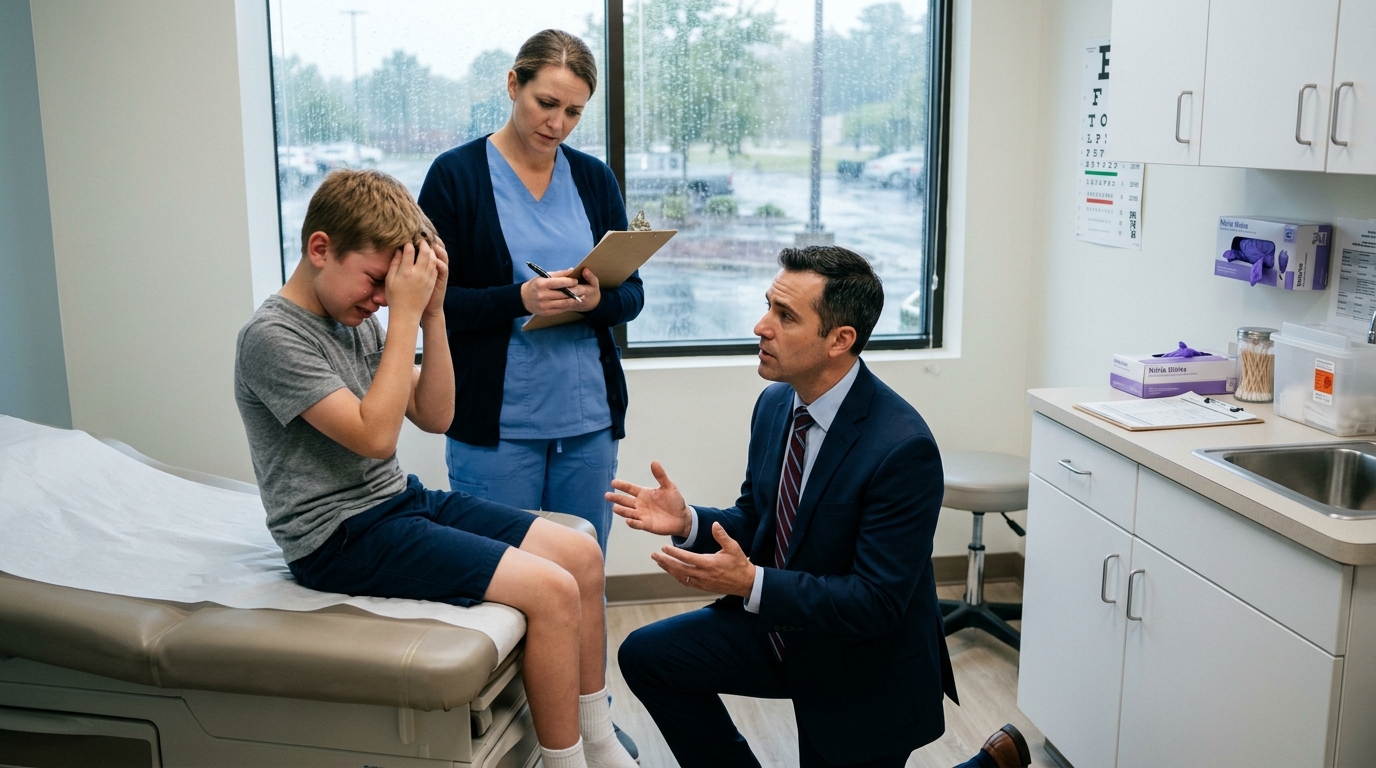
A boy arrived with twelve dollars and empty bottles to have his broken leg treated, but the doctor discovered he was the son who had been taken from her five years earlier: “Don’t hit me, I’ll be good.”
The clinic was supposed to close at six.
By 6:11 p.m., Emma Carter had already turned off the front sign, emptied the little trash can by the exam table, and rinsed the coffee pot nobody admitted to burning every afternoon.

Rain tapped hard against the front windows.
The waiting room smelled like wet pavement, antiseptic wipes, and the faint sourness of old coffee.
Her nurse, Megan, had her purse over one shoulder and her keys in her hand when the door opened again.
A little boy stood there.
He was soaked from head to toe, wearing a T-shirt so big it nearly reached his knees, and one shoe made a soft squishing sound every time he shifted his weight.
He was holding a plastic grocery bag against his chest like it contained everything he had left in the world.
Megan sighed before she saw his leg.
“We’re closed, honey,” she started.
The boy took one painful step inside.
“I have money,” he said.
His voice was quiet, careful, trained not to take up space.
Emma came around the counter.
The boy put the bag down with both hands and opened it.
Inside were sticky coins, two crushed cans, and three empty soda bottles with the labels peeling away from the plastic.
“The recycling man said it makes twelve dollars,” he said. “I can bring more tomorrow.”
Megan’s face changed.
So did Emma’s.
The boy’s right leg was swollen badly enough that the fabric above his ankle had stretched tight.
It was not just hurt.
It was wrong.
“What’s your name?” Emma asked.
“Noah,” he said.
“Okay, Noah. I’m Dr. Carter. I’m going to help you.”
He looked at her like she had used a word he did not trust.
Help.
Emma guided him toward the exam room, slow enough that he could limp beside her without being dragged.
When she touched his elbow, he flinched.
It was small, almost invisible.
But Emma had spent years treating children who explained bruises with practiced little lies.
She knew the language of flinching.
Megan shut the blinds in the front window and locked the door.
Not to keep the boy in.
To keep the world out until they understood what had happened.
Noah climbed onto the exam table with Emma supporting most of his weight.
He was lighter than he should have been.
His wet shirt clung to his back and showed the ridges of his shoulder blades.
Emma pulled on gloves and gently lifted the hem of his pant leg.
The swelling was bad.
The angle was worse.
Then she saw the other marks.
Old bruises, yellow at the edges.
Round burns, too small and too neat to be kitchen accidents.
Thin belt-shaped lines across his legs and arms.
Megan made a sound behind her and covered it quickly.
Emma kept her voice steady.
“Noah, can you tell me who hurt you?”
He stared at the ceiling tiles.
“I was bad.”
“What happened?”
“I spilled water. I didn’t clean it fast enough. Then I fell asleep before the dishes were done.”
Emma closed her eyes for one second.
One second was all she allowed herself.
Some people call cruelty discipline because the word sounds cleaner.
Some people call fear respect because it lets them sleep at night.
A child knows the difference.
When Emma reached for Noah’s ankle, he threw both arms over his head.
“Don’t hit me,” he cried. “Please. I’ll be good now.”
The words landed in the room like glass breaking.
Megan turned toward the cabinet, pretending to look for gauze because she was crying and did not want the boy to see it.
Emma leaned down until Noah could hear her without the whole room feeling loud.
“No one is going to hit you in here,” she said.
His arms stayed over his head for three more seconds.
Then four.
Then, slowly, he lowered them.
Emma cleaned the cuts first because routine kept her hands from shaking.
She photographed the visible marks for the medical file at 6:18 p.m.
She wrote down locations, sizes, colors, and Noah’s exact words on an incident intake note.
She had Megan bring the small digital X-ray plate from the supply shelf.
Not because the clinic was enough to handle a break like that.
It was not.
But proof mattered.
Proof mattered when wealthy families knew how to make ugly things sound accidental.
Proof mattered when children were too scared to tell the whole truth.
While Megan warmed a cup of soup in the break room microwave, Emma examined Noah’s face more closely.
That was when the room seemed to narrow.
The straight brow.
The small, stubborn chin.
The eyes.
Huge brown eyes, shaped like hers, watching every movement with too much caution for a five-year-old.
Emma’s breath caught.
“What’s your father’s name?” she asked.
Noah’s fingers twisted in the paper sheet beneath him.
“Michael Hayes.”
Emma did not move.
Megan looked up.
The name belonged to a different life.
Five years earlier, Michael Hayes had been Emma’s husband.
He had come from a family whose name opened doors in every medical building within fifty miles.
His mother chaired boards, funded clinics, and smiled from newspaper photos in pearls that looked too expensive for daylight.
Emma had been the woman they tolerated until she became inconvenient.
She had loved Michael when he still seemed capable of standing against them.
She had trusted him when he promised their baby would never be used as leverage.
Then the baby was born.
Then the papers came.
Michael’s mother sat beside Emma’s hospital bed with a folder, a pen, and a voice that made threats sound like concern.
She said the baby would have stability.
She said Emma had no money for a legal fight.
She said a child deserved more than a rented apartment above a closed dry cleaner and a mother with no family name anyone respected.
Emma had been feverish, exhausted, and alone.
She signed because they told her she would still receive updates.
She signed because Michael did not come into the room.
She signed because grief can make survival look like agreement.
No updates ever came.
For five years, Emma imagined her son in clean clothes, private schools, safe bedrooms, and birthday parties where someone cut the crusts off his sandwiches.
She told herself that lie until she could breathe around it.
Now he was on her exam table with a broken leg and twelve dollars in trash.
Megan brought the soup.
Noah accepted it with both hands.
“Thank you,” he whispered.
He ate quickly but carefully, without letting a drop fall.
When he finished, he tried to climb down from the table.
“What are you doing?” Emma asked.
“I’ll wash it.”
“You don’t have to wash anything.”
His face went blank with confusion.
Then pain hit him.
His leg buckled.
Emma caught him before he fell.
The bowl clattered against the tray.
“I’m sorry,” he gasped into her shirt. “I’m sorry, I’m sorry.”
Emma held him and looked over his head at Megan.
Megan was pale.
“Call the hospital intake desk,” Emma said quietly. “Tell them we have a pediatric injury case coming. Don’t give a last name yet.”
Megan nodded.
Emma carried Noah into the small back office where they kept a cot for long nights.
His skin was fever-hot.
He fought sleep as if sleeping might cost him something.
“You can rest,” she told him.
He stared at her.
“Will you lock the door?”
“No.”
“Will I still get dinner?”
“Yes.”
He seemed to consider that.
Then he whispered, “I’m going to try not to cry.”
Emma had heard children scream.
She had heard adults beg.
She had heard bad news delivered in hallways and waiting rooms and parking lots.
Nothing had ever hurt like that sentence.
At 6:47 p.m., she opened a new incident note.
She photographed the bottles, the cans, the sticky coins, the split sneakers drying near the space heater, and the little boy sleeping under a faded clinic blanket.
Then Noah murmured in his sleep.
“Don’t lock me in. Noah will listen.”
Emma’s hand hovered over her phone.
Michael’s number was still in her memory, though she had deleted it years before.
Some numbers stay in the body even after the name is gone.
She dialed.
He answered on the second ring.
“Emma?”
His voice was deeper than she remembered.
Older.
More tired.
She did not say hello.
“I found Noah.”
The silence lasted long enough that she heard Megan talking in the front room, low and careful, to someone at the hospital intake desk.
“Is he with you?” Michael asked.
“Yes.”
Another silence.
“Emma, where are you?”
“I want to know something first,” she said. “Did you know your son’s leg was healing wrong because someone kept hurting him?”
Something crashed on his end.
A chair, maybe.
A glass.
His breathing changed.
“Where are you?”
Emma hung up.
Twenty minutes later, headlights washed across the front window.
A black SUV pulled to the curb, stopping beside the mailbox near the clinic steps.
Michael stepped out into the rain without an umbrella.
His suit jacket darkened instantly.
He looked up at the clinic sign like he had walked into a punishment he had earned years ago.
For one ugly heartbeat, Emma wanted to leave him outside.
She wanted him cold.
She wanted him scared.
She wanted him to stand there long enough to understand one fraction of what Noah had carried in a body too small for that much fear.
Instead, she opened the door.
“Come with me,” she said.
Michael followed her through the waiting room.
He looked at the small American flag by the sign-in clipboard, the wet floor mat, the cup of soup on the counter, the bag of bottles beside the intake forms.
His eyes stopped on the coins.
“What is that?” he asked.
“What he brought to pay me.”
Michael’s face drained.
Emma did not comfort him.
Comfort was for children with broken legs, not men who had trusted powerful people because it was easier than asking hard questions.
She led him to the back office.
Noah was sleeping on the cot with one hand tucked under his cheek.
His other arm was curled over his head, even in sleep.
Emma pulled the blanket back carefully.
Michael saw the leg first.
Then the bruises.
Then the burns.
Then the old marks across the skin.
He stopped breathing like a man trying not to fall.
“Who did this?” he asked.
Emma looked at him.
“That’s what I was hoping you would tell me.”
He stepped closer to the cot.
His hand shook when he reached for Noah’s forehead.
Noah flinched before the touch landed.
His arms flew up over his head.
“Don’t hit me,” he cried in his sleep. “Don’t lock me up. I won’t do it again.”
Michael jerked his hand back like the words had burned him.
That was the moment Emma saw fear on his face.
Real fear.
Not embarrassment.
Not anger at being accused.
Fear.
Noah’s eyes opened.
For a few seconds, he looked at Emma first.
Then he turned his head and saw Michael.
The whole room went still.
“Daddy?” Noah whispered.
Michael grabbed the metal cabinet beside him.
The word almost took his knees out.
He lowered himself slowly beside the cot, but this time he kept both hands where Noah could see them.
“Noah,” he said.
Noah studied him the way children study weather, trying to decide whether to run before the storm hits.
“Grandma said if I cried, you’d send me away for good,” he whispered.
Michael shut his eyes.
Emma watched him absorb it.
Watched the family story collapse in his face.
Watched the polished Hayes name turn into something useless under fluorescent light.
Megan appeared in the doorway holding the intake clipboard.
Her face had gone gray.
“I’m sorry,” she said. “I found something while I was cutting the wet shirt seam so we could check his ribs.”
She set a small folded hospital bracelet on the counter.
It was old, cracked, and tiny.
One printed line was still visible.
BABY BOY CARTER-HAYES.
Michael stared at it.
Noah looked worried.
“Am I in trouble for keeping it?” he asked.
Michael covered his mouth with one shaking hand.
Then he folded forward.
Not loudly.
Not theatrically.
He simply bent over beside the cot as rainwater dripped from his sleeves onto the tile.
Emma picked up the bracelet.
Her thumb moved over the faded letters.
Five years of lies fit on a piece of plastic smaller than her palm.
She looked at Michael.
“Your mother told me he was safe,” she said.
Michael did not lift his head.
“She told me you didn’t want updates,” he whispered.
Emma went still.
“What?”
“She said you signed everything and left town. She said you didn’t want contact. She said sending photos would only make you come back and confuse him.”
Emma laughed once.
It was not humor.
It was the sound a person makes when grief finds a new door in a house she thought she had already searched.
Megan looked between them and tightened her arms around the clipboard.
“Dr. Carter,” she said softly, “hospital intake is expecting him. They said to bring the file and the photos.”
Emma nodded.
Michael looked up.
“I’m coming.”
“No,” Emma said.
He froze.
“You can follow,” she said. “You can answer questions. You can tell the truth. But you are not walking in there like the injured parent when he came to me with bottles to pay for his own care.”
Michael accepted that without argument.
That scared her more than if he had fought.
A guilty man argues.
A frightened one listens.
They transferred Noah carefully into Emma’s car because he clung to her sleeve whenever anyone else moved too close.
Michael followed in the black SUV, headlights steady behind them through the rain.
At the hospital, the intake nurse took one look at Noah and changed her tone.
The medical bracelet went around his wrist.
Forms were printed.
A pediatric specialist was called.
A police report was started in a family consultation room with beige walls, a box of tissues, and a framed map of the United States near the door.
Noah did not cry during the X-rays.
He only asked whether crying would make the machine take longer.
The nurse who heard him turned away for a second.
Michael stood in the hallway and made phone calls Emma could only hear in fragments.
“No, Mother, listen to me.”
“No, you do not get to say he’s dramatic.”
“No, I saw him.”
Then his voice dropped.
“If you leave that house before officers arrive, I will tell them where you keep every file.”
Emma sat beside Noah while the doctor explained the leg.
It had been injured before.
It had healed badly.
Then it had been injured again.
The specialist used careful language because Noah was in the room, but Emma understood every word beneath it.
Pattern.
Delay.
Neglect.
At 10:32 p.m., a social worker came in with a folder and asked Noah if he felt safe going home.
Noah looked at Emma.
Then at Michael.
Then at the door.
“No,” he said.
It was the bravest word Emma had ever heard.
Michael sat down hard in the chair against the wall.
The social worker nodded as if she had been waiting for the truth to get enough air.
“Okay,” she said. “Then we are going to make a different plan tonight.”
Noah reached for Emma’s hand.
She gave it to him.
Michael watched, and for once he did not ask for something that was not his to demand.
By midnight, the hospital file included the intake form, the X-ray report, the photographs, Emma’s clinic notes, and Noah’s statements.
Megan drove over with the original bag of bottles and coins sealed in a clear evidence pouch because she had thought to preserve everything.
Emma nearly cried when she saw it.
Competence is sometimes love in work shoes.
At 1:14 a.m., Michael’s mother arrived.
She came in wearing a cream coat and the same calm expression Emma remembered from the day she signed away her child.
Michael met her outside the room.
Emma stood inside the doorway where Noah could still see her.
“You have no idea what this looks like,” his mother said.
Michael’s voice was quiet.
“I know exactly what it looks like.”
“He is a difficult child.”
“He is five.”
“He exaggerates.”
“He asked if crying would make an X-ray take longer.”
For the first time, the older woman’s face changed.
Just a little.
Enough.
Emma stepped into the hall holding the cracked hospital bracelet.
“You told me he would have a better life,” she said.
Michael’s mother looked at the bracelet, then at Emma.
“That was never yours to keep.”
Emma smiled then.
Not because anything was funny.
Because some people reveal themselves when they think the room still belongs to them.
A police officer turned the corner with the hospital social worker.
The older woman looked past Emma, then back at Michael.
“What have you done?” she asked.
Michael did not answer right away.
He looked through the doorway at Noah, who was half-asleep with Emma’s hand still in his.
Then he said, “For once, what I should have done five years ago.”
The investigation did not end that night.
Stories like this never end neatly in one hallway.
There were hearings.
There were statements.
There were family members who suddenly forgot what they had seen and staff members who remembered everything once they were no longer afraid of losing their jobs.
There were medical records that did not match the explanations given at home.
There were old school notes about Noah falling asleep in class.
There were neighbors who had heard crying and told themselves it was not their business.
Emma learned to hate that phrase.
Not my business.
A child had dragged himself through the rain with empty bottles because too many adults had decided his pain was not their business.
Temporary custody was granted while the case moved forward.
Noah stayed with Emma in the apartment above the clinic at first.
He slept with the light on.
He hid crackers under his pillow.
He apologized when he used too much toothpaste.
He asked three times the first morning whether breakfast cost money.
Emma answered each question without crying in front of him.
“No.”
“No.”
“No, baby.”
Michael came every day, but he knocked first.
He waited to be invited.
He brought paperwork, medical releases, and eventually a written statement admitting what he had ignored, what he had trusted, and what he had failed to question.
He did not ask Emma to forgive him.
That was the first decent thing he had done.
Weeks later, Noah sat at Emma’s kitchen table with a cast on his leg and soup cooling in front of him.
The little American flag from the clinic counter had been moved to the windowsill because Noah said it made the apartment look like “a place people can find.”
He ate slowly now.
Sometimes he still watched the door.
Sometimes he still flinched when a cabinet closed too hard.
Healing did not arrive like a movie ending.
It arrived in small, stubborn proofs.
A full bowl left unfinished because he believed there would be more later.
A night-light turned off before dawn.
A laugh that surprised him.
One Saturday morning, he handed Emma the cracked baby bracelet.
“I kept it because I thought maybe somebody was looking for me,” he said.
Emma closed her hand around it and pulled him gently against her.
“I was,” she whispered.
He leaned into her, careful of the cast.
“Did I do good finding you?”
Emma looked down at the boy who had crossed a rainy street with twelve dollars and empty bottles because some part of him still believed help existed.
“You did more than good,” she said. “You came home.”
For five years, Emma had told herself her son was safe because the alternative would have destroyed her.
Now she knew the truth.
Safety had never been a family name, a big house, or a clinic wing with polished floors.
Safety was a door that opened when a child knocked.
Safety was an adult who believed him the first time.
Safety was a mother who finally got to say no one was sending him back.
And every time Noah passed the clinic counter and saw those old bottles sitting on the high shelf where Emma kept them, he asked the same thing.
“Why do you keep trash, Mom?”
Emma always gave him the same answer.
“Because that was never trash.”
Then she would touch the little plastic hospital bracelet in her pocket and look at the child who had once tried to buy mercy with twelve dollars.
“It was how you found your way back to me.”