Pregnant And Broke In Divorce Court, She Learned Who She Really Was…..
The courtroom smelled like stale coffee, damp wool, and paper that had passed through too many hands.
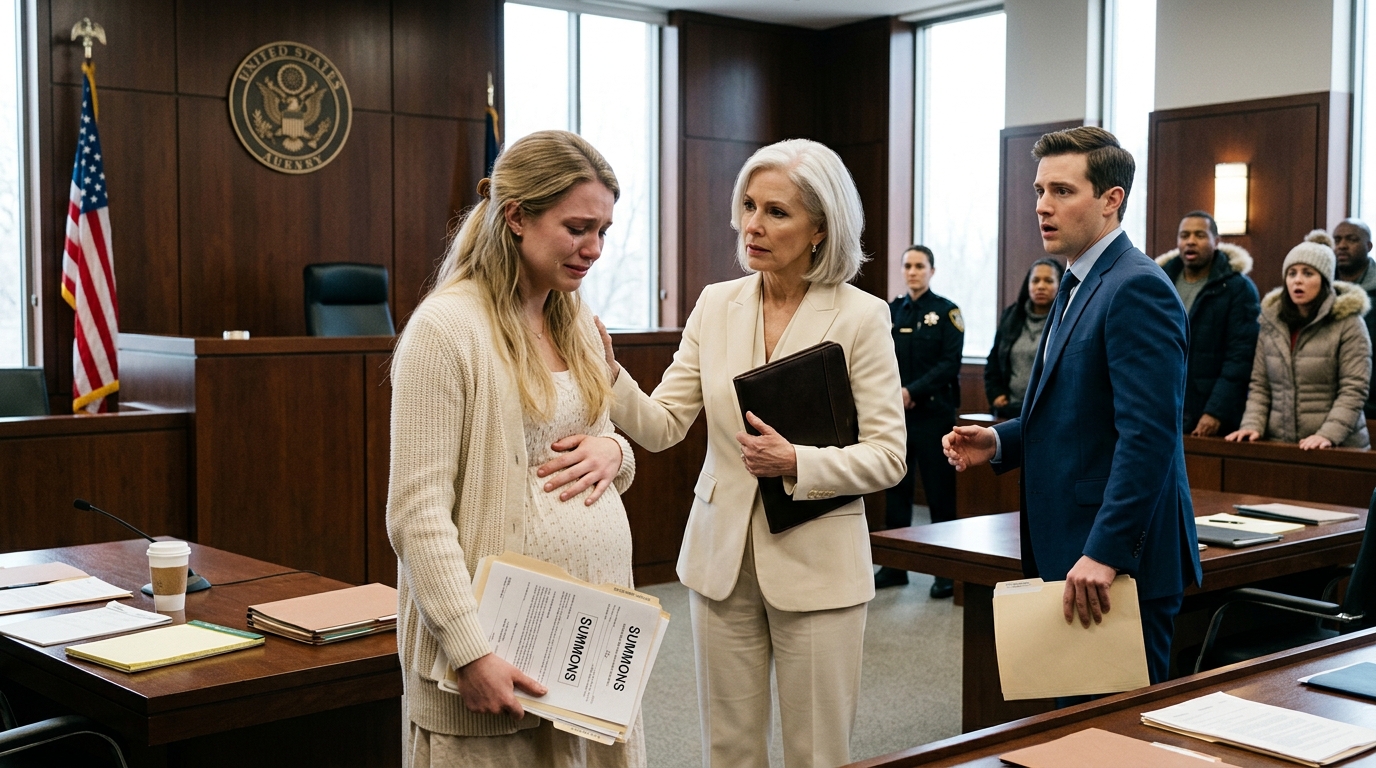
Clara Bennett sat at the petitioner’s table with one hand under her ribs, trying to breathe through another hard kick from the baby she had been carrying for eight months.
Her son moved like he could feel the room closing around them.

Above the judge’s bench, the American flag stood still beside a civic seal, ordinary and formal and strangely indifferent.
The fluorescent lights hummed.
Somebody behind Clara coughed into a sleeve.
Julian sat across from her in his clean navy suit, his legs crossed, one polished shoe bouncing slightly under the table.
He looked relaxed.
That was what scared her most.
For months, he had acted wounded.
He told neighbors he had tried everything.
He told his attorney Clara was unstable, dependent, and impossible to reason with.
He told mutual friends that he wanted to do right by the baby, but Clara had made that hard.
In private, he had told Clara the truth.
“You don’t have anyone,” he had said one night in their kitchen while she stood barefoot beside a sink full of dishes. “That matters more than you think.”
At the time, she thought it was cruelty.
Now, sitting in family court with a stamped packet in front of her, she understood it had been strategy.
Julian had always known where to press.
Clara had grown up in foster care with a manila folder instead of a family tree.
Every important fact about her childhood lived on state forms, school transfers, clinic notes, and signatures from adults who remembered her only because the paperwork required them to.
She had learned early not to ask too many questions.
Questions made people uncomfortable.
Questions reminded foster parents that you were not really theirs.
Questions made caseworkers sigh and say, “We’re doing our best.”
By seventeen, Clara had stopped asking why no one had ever come for her.
By twenty-two, she had convinced herself that not being chosen was not the same as being unwanted.
Then she met Julian.
He was charming in the easy way that made waitresses laugh and older men call him sharp.
He remembered details.
He brought coffee when she worked double shifts.
He said things like, “You shouldn’t have to carry everything alone.”
For a woman who had spent her life packing quickly because nothing was permanent, that sounded like love.
Clara gave him the trust signal she had never given anyone else.
She told him she had no safety net.
No parents.
No siblings.
No aunt in another state.
No friend with a spare bedroom who would come get her at midnight.
At first, Julian treated that confession gently.
Later, he used it like a map.
He learned exactly how alone she was, then built the marriage around that fact.
When they were struggling, Clara picked up extra shifts and told herself they were a team.
When Julian needed a better suit for interviews, she paid for it with a credit card she should not have used.
When rent was late, she called the landlord and swallowed the shame.
When he got angry, she apologized first because keeping peace felt safer than being right.
Then she got pregnant.
For about three weeks, Julian acted delighted.
He touched her stomach in grocery aisles.
He talked about cribs.
He sent one ultrasound picture to his mother and wrote, “Bennett legacy incoming.”
Then the bills arrived.
Then the appointments interfered with his schedule.
Then her body changed in ways he found inconvenient.
By the sixth month, he was staying out later.
By the seventh, he had moved money out of their joint account.
By the eighth, she was in court listening to his lawyer explain why Clara deserved nothing from the marriage.
At 9:17 a.m., the county family court clerk stamped the final packet.
At 9:44 a.m., Julian’s attorney submitted his sworn disclosure.
At 10:03 a.m., Judge Carter began reading the ruling.
Clara heard only pieces at first.
No marital home interest.
No spousal maintenance.
Separate assets retained by respondent.
Insufficient documented contribution.
Her ears rang.
The baby kicked again, harder this time.
Judge Carter did not sound cruel.
That almost made it worse.
Cruelty would have given Clara something to fight.
This was process.
This was forms and signatures and rules applied to a life that had already left her with almost nothing.
Julian’s attorney kept his eyes down.
The bailiff glanced once at Clara’s stomach, then away.
Two women in the back row shifted on the bench.
Clara wondered whether one of them had a daughter.
She wondered whether either of them would think about her later in the car.
The gavel came down.
One clean sound.
Final.
Julian’s mouth curved.
It was small, that smile.
Small enough that no one could accuse him of gloating.
Large enough that Clara saw every bit of it.
He leaned toward her while the judge turned to the next page.
His cologne reached her first, sharp and expensive, layered over the stale courtroom air.
“Let’s see how you survive without me, Clara,” he whispered.
She kept her eyes on the table.
“You came from nothing,” he said. “You’re going back to nothing.”
For one second, Clara saw their whole marriage from above.
Not romance.
Not partnership.
Not a man who had lost his way.
A plan.
A man studying her emptiest places and waiting until she was too pregnant, too tired, and too alone to run.
Her fingers curled around the divorce packet.
The paper bent under her thumb.
She wanted to throw it at him.
She wanted to stand up and tell the judge about the transfers, the locked accounts, the nights Julian left her with a debit card that declined at the pharmacy.
She wanted to tell everyone that she had built half of his life quietly and he had filed paperwork pretending she had never existed.
Instead, she placed her left hand on her belly and breathed.
The baby shifted beneath her palm.
She had no room for rage if rage made her careless.
That was one of the few things foster care had taught her well.
Survival sometimes looked like silence.
Not surrender.
Silence.
Clara pushed herself up from the chair.
The scrape of wood against the floor sounded too loud.
Her legs trembled.
She tucked the stamped papers against her side and thought about the bus stop outside the courthouse.
It was February cold beyond those windows.
She had eleven dollars left on a grocery card, a half-packed suitcase in the trunk of an old car that did not always start, and a baby due before the month was over.
She did not have a plan.
She had movement.
Sometimes that was all a woman had left.
Then the courtroom doors slammed open.
The sound cracked through the room.
Every head turned.
The bailiff stepped forward, one hand lifted.
Four men in dark tactical suits entered first, not running, not shouting, just moving with the kind of control that made everyone else instinctively still.
One stood near the left exit.
One near the aisle.
One by the back wall.
One stayed beside the door.
Judge Carter straightened.
Julian’s attorney rose halfway from his chair.
“What is the meaning of this?” the judge began.
Then Eleanor Sterling walked in.
The room knew her before Clara did.
A ripple moved through the benches.
Someone whispered her name.
Julian stood too quickly, knocking his knee against the table.
Eleanor Sterling was not famous in the way celebrities were famous.
She was famous in the way banks were famous.
Quietly.
Powerfully.
With consequences attached.
Her companies appeared in business sections and courthouse filings.
Her name sat on hospital wings, scholarship funds, and acquisition rumors.
People described her as ruthless when they admired her and ruthless when they feared her.
She wore white cashmere, a cream dress, and low heels that made almost no sound as she crossed the courtroom floor.
Her silver hair was pulled back.
Her face was composed.
But her eyes were not.
Clara saw them and forgot to breathe.
Icy blue.
Clear, bright, almost impossible.
The same eyes Clara had seen in every mirror of every temporary bedroom she had ever slept in.
The same eyes adults used to call striking before they changed the subject.
Julian recovered first because Julian always recovered first.
“Mrs. Sterling,” he said, smoothing his jacket. “This is unexpected. I’m Julian Bennett. I’m sure there’s been some kind of confusion.”
Eleanor passed him as if he were furniture.
His hand remained extended in the air.
A few people in the gallery noticed.
That was the first time Clara saw fear touch his face.
Eleanor stopped in front of Clara.
For a moment, neither woman moved.
Clara could smell cold air on the older woman’s coat, like she had come straight from outside.
Eleanor lifted one hand.
Diamonds flashed on her fingers, but the hand itself trembled.
She touched Clara’s cheek so gently it broke something open in Clara’s chest.
“My beautiful girl,” Eleanor whispered.
The words were not polished.
They were not public words.
They came out torn.
“I finally found you.”
Clara’s knees weakened.
She gripped the edge of the table.
The baby kicked beneath her hand.
Girl.
Daughter.
Found.
The words did not fit the life she knew.
Clara Bennett had been the child nobody claimed.
The girl whose backpack stayed packed.
The teenager who signed her own school forms whenever adults forgot.
The woman who learned not to stare too long at families in diners because wanting something did not make it yours.
Julian laughed.
It came out too high.
“Your daughter?” he said. “Mrs. Sterling, Clara is an orphan.”
Eleanor did not look away from Clara.
“No,” she said.
The whole courtroom seemed to lean toward that word.
“She was taken from a hospital nursery thirty years ago after a records breach and a fraudulent discharge. She was never abandoned. She was never unwanted. And she was never yours to destroy.”
Julian’s face changed.
Not fully.
Only around the mouth.
His smile tried to hold and failed at the edges.
Judge Carter’s expression sharpened.
“Mrs. Sterling,” he said carefully, “if you have documentation relevant to identity or financial disclosure, you will provide it through proper procedure.”
“I intend to, Your Honor,” Eleanor said.
She turned and opened the leather folder in her hand.
The first document she placed on the table was an old hospital intake form.
The paper was protected inside a clear sleeve.
Clara saw a typed date.
She saw a newborn female notation.
She saw a line marked eye color.
Blue.
Then she saw a name she did not recognize.
A name that might have been hers before the world renamed her by accident, neglect, or crime.
Clara’s vision blurred.
Eleanor’s fingers stayed steady now.
The tremor was gone.
“This is not a performance,” Eleanor said. “It is a chain of custody. Hospital intake record. Discharge log. Foster placement transfer. DNA confirmation. Court-certified petition for emergency identity review.”
The words moved through the courtroom like a second ruling.
Julian’s attorney reached for the document, then stopped and looked at the judge.
Judge Carter nodded once.
The attorney read only the top page before his posture changed.
Julian noticed.
“What?” he snapped.
His lawyer did not answer.
That silence frightened him more than any accusation could have.
Eleanor placed the second page down.
This one was newer.
A lab report.
Clara recognized the format from prenatal testing forms and medical portals.
There were numbers, signatures, a collection date, and a conclusion line.
Eleanor’s voice softened.
“I have spent thirty years looking for my child,” she said. “I have found graves, false leads, sealed files, forged signatures, and people willing to be paid for forgetting. Last month, a records clerk found a duplicate file number in an archive box that should have been destroyed.”
Clara covered her mouth.
She did not cry loudly.
She barely made a sound.
But tears slipped down her cheeks faster than she could stop them.
An entire life had taught her to wonder whether she deserved to be left.
Now a stranger with her eyes was telling her that leaving had never been the truth.
Julian stepped back from the table.
“This has nothing to do with our divorce,” he said.
There it was.
Not shock.
Not compassion.
Not even curiosity about the pregnant wife who had just learned her entire identity might be wrong.
Money.
Control.
The ruling.
The thing he thought he had won.
Eleanor looked at him then.
The warmth vanished from her face.
“You are correct about one thing,” she said. “The identity record is not the only reason I am here.”
She reached into the folder again.
Julian’s attorney went still.
Clara saw it.
So did the judge.
The next document was not old.
It was a bank transfer ledger.
The top line carried a timestamp from that morning.
6:42 a.m.
Clara stared at Julian.
His face had gone pale under the courtroom lights.
Eleanor slid the ledger toward Judge Carter’s clerk.
“My team received this at 8:11 a.m.,” she said. “It appears to involve marital funds moved through an account not disclosed in Mr. Bennett’s sworn financial statement.”
Julian’s lawyer whispered something under his breath.
It sounded like a prayer and a curse at the same time.
Judge Carter took the page.
The room became painfully quiet.
The kind of quiet that makes tiny sounds cruel.
A pen clicked somewhere.
A woman in the back row inhaled sharply.
The paper coffee cup near Julian’s attorney buckled slightly under his grip.
Julian looked at Clara as if she had done something to him.
That was almost funny.
He had stripped her life down to nothing in open court, and now he looked betrayed because the floor had opened under his own feet.
“Your Honor,” Julian’s attorney said, standing fully now, “I request a brief recess to review—”
“No,” Judge Carter said.
The word landed flat.
The attorney stopped.
Judge Carter looked at Julian.
“Mr. Bennett,” he said, “did you submit a sworn financial disclosure to this court?”
Julian swallowed.
“Yes.”
“Did that disclosure include all accounts under your control or beneficial access?”
Julian looked at his lawyer.
The lawyer did not rescue him.
“Yes,” Julian said again, but this time it sounded smaller.
Eleanor’s mouth did not move.
She did not smile.
She did not gloat.
That restraint was somehow more frightening than rage.
She had not come to embarrass him.
She had come prepared.
There is a difference between revenge and documentation.
Revenge wants a scene.
Documentation waits until the lie signs its own name.
Judge Carter reviewed the ledger in silence.
Then he looked toward the clerk.
“Mark this for review,” he said.
Clara felt Eleanor’s hand find hers.
The contact was careful, as if Eleanor was asking permission without words.
Clara did not pull away.
For once, someone was standing beside her without needing to be begged.
Julian’s mother sat in the back row.
She had come wearing pearls and a satisfied expression, prepared to watch Clara leave with nothing.
Now both hands covered her mouth.
Her eyes stayed locked on Julian.
Clara wondered what story Julian had told her.
Probably that Clara was greedy.
Probably that Clara was trying to trap him with the baby.
Probably that he was the victim, because Julian was always the victim in stories Julian told first.
But paperwork has a way of ruining performance.
Judge Carter set the ledger down.
“Mr. Bennett,” he said, “before your counsel says another word, I suggest you prepare yourself for a very different hearing than the one you believed you were attending.”
Julian’s lips parted.
No sound came out.
That was when Clara finally understood that the ruling she had heard minutes earlier was no longer the end of her story.
It was evidence of how close he had come.
Eleanor turned back to Clara.
“I know this is too much,” she said softly. “I know I have no right to ask anything from you today.”
Clara wiped her face with the heel of her hand.
Her voice came out rough.
“What was my name?”
Eleanor closed her eyes.
The question hit her harder than Julian’s panic had.
When she opened them, they were full of grief.
“Emily,” she said. “Emily Rose Sterling.”
The name moved through Clara like a memory she did not have.
Emily.
Not better than Clara.
Not more real.
But earlier.
A door behind a door.
Clara looked down at her belly.
Her son shifted again, softer now.
For months she had wondered what kind of family she could give him when she had never been shown how to keep one.
Now she was standing in a courtroom between the man who tried to erase her and the woman who had spent thirty years trying to find her.
Judge Carter ordered the ruling paused pending review of the new evidence.
Julian’s attorney asked for a recess.
This time, the judge granted ten minutes, but he made clear that no one was leaving the building.
The bailiff moved closer to Julian’s table.
Not dramatically.
Just enough.
Julian saw it and sat down.
Clara remained standing because sitting felt impossible.
Eleanor stayed beside her.
In the hallway, the cold courthouse air hit Clara’s face.
People pretended not to stare and failed.
Eleanor’s assistants formed a loose circle, not trapping her, simply making room around her body as if she mattered.
That was new.
All her life, Clara had learned how to take up less space.
In that hallway, someone made space for her without being asked.
Eleanor did not rush her.
She did not demand a hug.
She did not call herself Mom.
She only took a paper coffee cup from one of her staff, placed it in Clara’s shaking hands, and said, “Small sip. You look like you might faint.”
Clara almost laughed.
That ordinary instruction did what the dramatic revelations could not.
It made Eleanor real.
Not a billionaire.
Not a headline.
A woman watching her daughter’s hands shake and trying to fix the one thing in reach.
Julian came into the hallway two minutes later with his attorney beside him.
His face was tight.
He looked from Eleanor to Clara and back again.
“You don’t know her,” he said.
Eleanor’s expression did not change.
“I know enough.”
“You know records,” Julian snapped. “You don’t know what she’s like.”
Clara flinched before she could stop herself.
Eleanor noticed.
The temperature in her face changed.
“I know what it looks like when a man thinks a woman’s isolation is an asset,” Eleanor said. “And I know what it looks like when he discovers it was not.”
Julian’s attorney touched his sleeve.
“Stop talking,” he whispered.
Julian shook him off.
“She’s carrying my child.”
Clara’s grip tightened around the coffee cup.
Eleanor stepped closer, not touching him, not threatening him, just removing the space he had been using to loom.
“She is carrying her child,” Eleanor said. “You would be wise to remember the difference.”
For the first time, Clara saw Julian look small.
Not because Eleanor was louder.
Because she was not afraid of him.
When they returned to the courtroom, Judge Carter had reviewed enough to reopen the matter on the record.
He did not reverse everything that day.
Real courts do not work like lightning.
But he suspended the final order.
He ordered a review of Julian’s financial disclosures.
He required production of account records.
He allowed Eleanor’s counsel to submit the identity petition through proper channels.
He warned Julian, clearly and publicly, that sworn statements were not suggestions.
Every sentence took something from Julian.
Not money yet.
Not freedom.
Something more immediate.
Certainty.
The certainty that Clara was alone.
The certainty that no one would check his work.
The certainty that a foster kid with a swollen belly could be pushed out into the cold and forgotten by lunch.
When the hearing ended, Julian did not smirk.
He gathered his papers too quickly.
One folder slipped and scattered across the table.
A few sheets slid to the floor.
No one helped him pick them up.
Clara watched him bend for them and felt no triumph.
Only distance.
That surprised her.
She had spent so long afraid of his power that she expected his humiliation to feel like freedom.
It did not.
Freedom felt quieter.
Freedom felt like Eleanor walking beside her down the courthouse steps, matching her pace because pregnancy made every step slower.
Freedom felt like the winter air hitting Clara’s face and not knowing where she would sleep that night, but knowing for the first time that the answer would not depend on Julian’s mercy.
Outside, an SUV waited at the curb.
A small American flag moved above the courthouse entrance behind them.
Eleanor stopped before the car door opened.
“I have a home,” she said. “I have lawyers. I have doctors. I have more answers than I had yesterday and fewer than I want.”
Clara looked at her.
Eleanor’s eyes filled again.
“But I will not tell you what to do,” she said. “You have had enough people making decisions over your life.”
That sentence undid Clara more than any promise of money could have.
Julian had offered protection and meant control.
Eleanor offered help and left the door open.
Clara touched her belly.
“What if I don’t know how to be your daughter?” she asked.
Eleanor’s face broke.
“Then we learn carefully,” she said. “And I earn whatever name you decide to call me.”
Clara cried then.
Not pretty tears.
Not quiet ones.
The kind of crying that bends your shoulders and makes strangers look away because they understand they are seeing something private.
Eleanor did not grab her.
She waited.
When Clara leaned forward first, Eleanor held her like someone receiving something fragile and long-lost.
For thirty years, Clara had believed she had come from nothing.
For one whole marriage, Julian had made sure she kept believing it.
But nothing had never been the truth.
The truth had been buried in hospital records, court files, copied signatures, and a mother who never stopped searching.
Weeks later, the financial review would uncover more than Julian ever meant anyone to see.
Months later, Clara would hold her son in a quiet hospital room while Eleanor sat beside the bed, not as a savior, not as a headline, but as a grandmother counting tiny fingers under a blanket.
The legal process would take time.
The identity case would take time.
Trust would take longer than both.
But the day Clara walked into court, Julian thought he was watching a woman leave with nothing.
He did not understand that the door swinging open behind her was not luck.
It was the past finally catching up.
And when it did, it came wearing white cashmere, carrying documents, and looking at Clara with the same impossible blue eyes she had spent her whole life seeing alone in the mirror.