Lisa Rinna’s Feathered Met Gala Pre-Party Gown Sparks Viral Debate Over Her Dramatic Y2K-Inspired Hairstyle, Sheer Black Dress, Red Feather Accents, and Bold Fashion Risks, As Fans and Critics Clash Online While Harry Hamlin’s Subdued Appearance Fuels Additional Commentary, Cementing Another Controversial Yet Unforgettable Celebrity Style Moment That Dominates Entertainment Headlines and Social Media Buzz
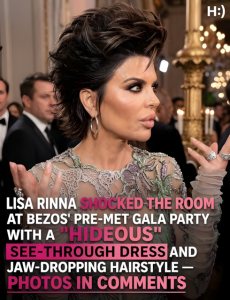
Lisa Rinna’s feathered gown didn’t simply appear as another celebrity outfit in a crowded season of red-carpet fashion—it emerged as a cultural flashpoint shaped by decades of her evolving public identity, her instinct for spectacle, and the modern internet’s appetite for instant judgment. The look became a talking point almost immediately because it fused theatrical styling with unmistakable confidence, the kind of deliberate risk that transforms clothing into conversation rather than decoration. In an era where celebrity fashion is often carefully curated to avoid backlash, Rinna’s approach stood out precisely because it refused caution. Whether viewed as artful expression or excessive display, the ensemble achieved the rare outcome that defines viral fashion moments: it demanded attention, sustained debate, and refused to fade quietly into the background. The outfit’s impact was not limited to its visual elements alone, but also to what it represented—an extension of Rinna’s long-standing relationship with reinvention, visibility, and the strategic use of bold aesthetics to maintain cultural relevance in an industry that often moves on quickly from familiar names.
To understand why this particular appearance resonated so strongly, it helps to consider the broader arc of Rinna’s public persona. Long before this pre–Met Gala moment, she had already established herself as someone unafraid of transformation, shifting from early Hollywood glamour into a more unpredictable and expressive fashion identity over time. In her earlier career phases, she often embodied a polished, classic aesthetic, relying on sleek silhouettes and minimal risk-taking that aligned with traditional celebrity styling. However, as her presence in reality television and pop culture commentary expanded, so did her willingness to experiment. She began embracing unconventional textures, exaggerated shapes, and provocative design choices that often blurred the line between fashion and performance. This evolution was not accidental; it reflected a conscious embrace of reinvention as a personal brand strategy. By the time she arrived at high-profile fashion events like the one hosted ahead of the Met Gala, Rinna had already cultivated an expectation that she would not simply attend—she would disrupt, reinterpret, and visually challenge whatever norms surrounded her presence.
The specific event in New York City on May 2, 2026, hosted by Jeff Bezos and Lauren Sánchez, provided the perfect backdrop for such a statement. Occurring just before one of fashion’s most scrutinized nights, the gathering carried an atmosphere of anticipation where celebrities often test stylistic boundaries before stepping onto the official Met Gala carpet. Rinna’s entrance into this environment was deliberate in its theatricality. She did not arrive in something subdued or transitional; instead, she leaned fully into maximal expression, as if acknowledging that pre-event gatherings have become their own runway within modern celebrity culture. In spaces like these, fashion is no longer just about elegance—it becomes a form of competitive visibility, where each attendee subtly vies for digital attention long before the main event begins. Rinna understood this dynamic and positioned herself accordingly, ensuring that her look would not merely be photographed, but circulated, dissected, and debated across platforms within hours.
The most immediately striking element of her appearance was the transformation of her hair, which played a crucial role in signaling the direction of her entire look. Known widely for her signature short hairstyle, Rinna chose to depart from familiarity by adopting a faux-hawk-inspired silhouette that evoked early-2000s rebellious styling while still maintaining a modern editorial sharpness. The sides were tightly controlled, emphasizing structure and discipline, while a vivid red crest rose from the crown, introducing both color contrast and visual tension. This choice was not simply aesthetic; it functioned as a narrative device, suggesting departure from expectation and a willingness to embrace unpredictability. In fashion terms, hair often acts as an emotional amplifier for an outfit, and in this case, it heightened the sense that Rinna was not merely dressing for admiration, but for impact. The transformation immediately became a focal point of online commentary, with audiences reacting to its unexpected intensity and its departure from her recognizable silhouette.
Her gown, however, was the true center of the conversation, combining multiple design languages into a single, deliberately provocative composition. The black base of the dress anchored the look in classic eveningwear tradition, but that foundation was disrupted by sheer netted elements that exposed and obscured simultaneously, creating a layered tension between visibility and concealment. Across the bodice, swirling fringe details introduced movement and texture, softening the structural elements while also adding visual complexity under lighting and camera flashes. The most dramatic feature came through the vivid red feather accents that cascaded from the arms, injecting both color and theatrical motion into the ensemble. These feathers did not function as subtle decoration; they acted as kinetic extensions of the garment, ensuring that even slight movement would produce a dramatic visual effect. The styling was completed with bold makeup choices and towering platform heels that further exaggerated scale and presence. Every component of the look was intentional in its amplification, designed not for subtle appreciation but for immediate recognition and sustained discussion.
Accompanying her was her husband, Harry Hamlin, whose understated attire created a deliberate contrast that only intensified the visual focus on Rinna herself. Dressed in a simple black suit, he appeared almost minimalistic in comparison, allowing the complexity of her ensemble to dominate the visual narrative of the evening. This contrast did not go unnoticed by observers, many of whom interpreted it through the lens of modern celebrity dynamics, where couples are often analyzed not just individually but relationally in terms of presence, energy, and perceived comfort. As photographs circulated online, commentary quickly split into opposing interpretations—some praised Rinna’s fearless commitment to fashion experimentation, while others questioned whether the styling was excessive or intentionally provocative. Yet beneath these divided opinions lay a shared acknowledgment that the look was effective in one fundamental way: it refused invisibility. In a digital environment where countless celebrity images compete for fleeting attention, Rinna’s appearance succeeded in anchoring itself firmly in public discourse.
Ultimately, the significance of the feathered gown extends beyond its immediate visual impact and into the broader context of how celebrity fashion functions in the current cultural moment. Rinna’s look did not exist in isolation; it intersected with her established reputation for reinvention, her ongoing engagement with public perception, and the internet’s tendency to amplify anything that disrupts expectation. Whether interpreted as bold artistic expression or calculated spectacle, the outfit achieved its essential purpose by generating sustained attention and polarized interpretation. In contemporary fashion culture, where virality often matters as much as elegance, this balance between admiration and critique becomes part of the design’s success. Rinna’s appearance demonstrated once again that she understands this dynamic intuitively. The gown was not simply worn—it was activated within a system of visibility, ensuring that long after the event ended, the conversation around it would continue.