Julián clenched his jaw. He didn’t look at me much….
“From today on, you are no longer a daughter of this house, Valeria. You are the wife of a man who needs someone to take care of his children.”
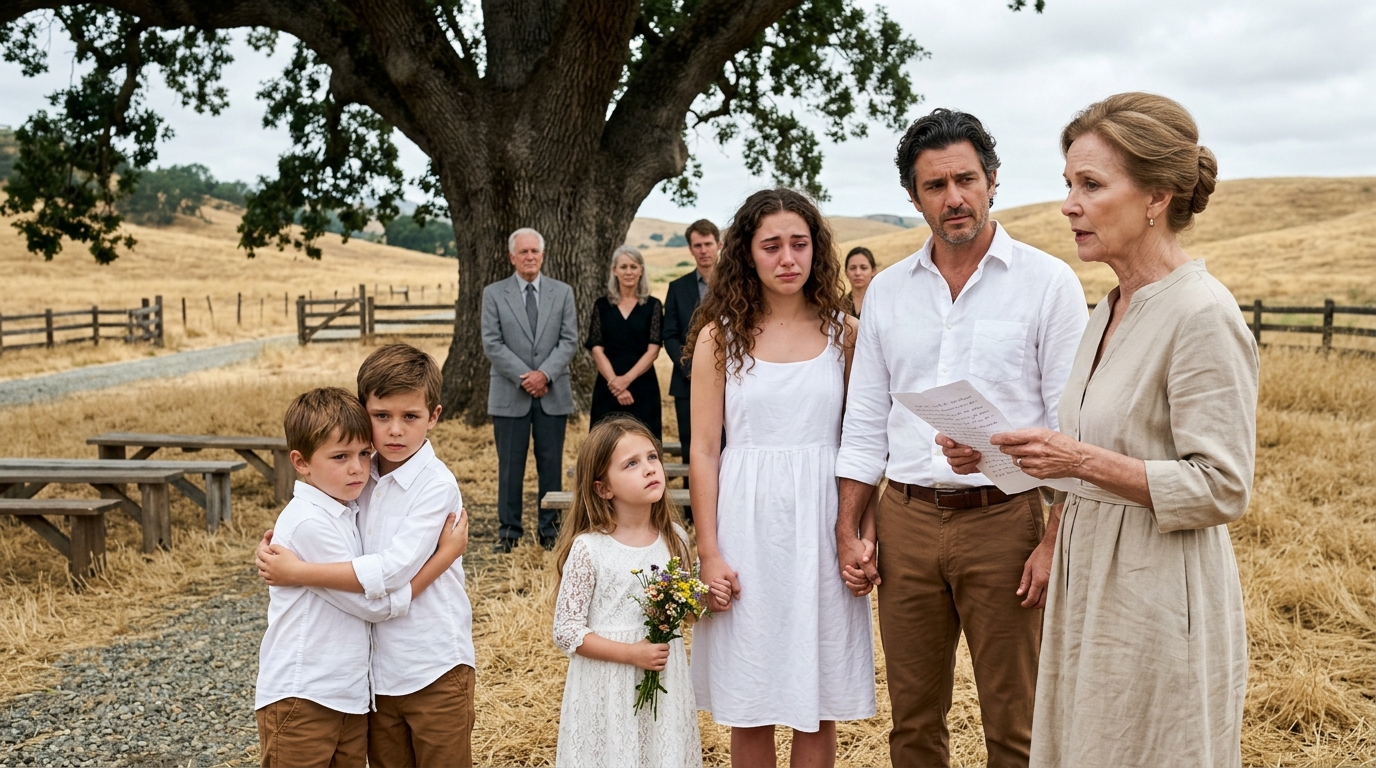
My aunt Ramona told me this in front of the broken mirror, while I adjusted a borrowed white dress that smelled of dampness and confinement. I was eighteen years old, and my hands trembled so much I couldn’t even hold my hair ribbon.
It was January, in a coffee-growing town in Veracruz, where the fog descended from the hills as if trying to hide everyone’s shame. My father had died when I was a child, my mother fell ill later, and when she passed away, my aunt inherited the house, the papers, and me.
He said I was supported by charity. But that morning I understood that charity can also have a price.
The man’s name was Julián Morales. He was thirty-seven years old, his skin tanned by the sun, and a deep sadness etched in his eyes. His wife, Clara, had died two years ago, leaving him with three children: Emiliano, nine; Toño, six; and Marisol, four.
“She’s quiet, hardworking, and doesn’t cause any trouble,” my aunt told Julian, as if she were selling a cow at the fair. “She knows how to sweep, cook something, do laundry, and take care of children.”
Julian clenched his jaw. He didn’t look at me much. He just placed a thick envelope and a bag of folded papers on the table.
Nobody asked if I wanted to.
That afternoon they put me in Julian’s truck with an old suitcase, two dresses, my mother’s earrings, and a lump in my throat that wouldn’t let me breathe.
Julian’s house was on the other side of the river, surrounded by coffee plantations, free-roaming chickens, and orange trees. It was clean, but silent. So silent that it seemed even the walls were still in mourning.
The children saw me from the doorway.
Marisol hid behind a chair. Toño looked at me as if I were an unwelcome guest. Emiliano, the eldest, blurted out without blinking:
—My mother is dead. You have no right to sit in her place.
I felt the blow to my chest, but I didn’t respond angrily.
“I didn’t come to sit in your place,” I said quietly. “I came because I was brought here.”
The first few days were a disaster.
I burned the rice. The clothes were stiff because I didn’t rinse the soap out properly. Marisol cried every time I tried to bathe her. Toño wouldn’t eat if I set the table. Emiliano would move the dishes around so I’d look useless.
Julian didn’t talk much. He would get up before dawn, go out to the coffee plantation, and return at night with his boots full of mud.
But every morning I found small notes next to the griddle.
“Marisol likes her milk lukewarm, not hot.”
“Toño gets scared by thunder.”
“Emiliano doesn’t hate soup. He hates being told what to do.”
One night I found another note under my cup:
“You don’t have to win their affection. Just don’t reject them back.”
That phrase stuck in my heart.
Then Marisol got sick.
His fever spiked suddenly. His little body was burning, and he called for Clara in his sleep. Julián went out to find the doctor, but the road was blocked by rain.
I stayed with her, changing her wet cloths, praying in a low voice, singing her a song that my mother used to sing to me when I was scared.
I spent two nights without sleep.
On the third dawn, Marisol opened her eyes, touched my face with her warm little hand and whispered:
—Don’t go, Mom Vale.
Julian was standing in the doorway.
She said nothing. But her eyes filled with something that wasn’t sadness.
For the first time I thought that maybe my life wasn’t over.
Until one night, while I was carrying water to the patio, I heard Julian talking to his brother.
“I married her because I had no choice,” he said. “The children needed a woman in the house. That was all.”
I was frozen.
She wasn’t a wife. She wasn’t family. She was a necessity in a white dress.
That morning I left a letter on the table:
“If I’m only useful, don’t ask me to stay until I forget myself.”
I set off towards the old road, with wet shoes and a broken soul.
And as I walked away, no one imagined that my escape would uncover a lie capable of destroying the entire family…
PART 2: The debt that bore my name
Julian found me near the bridge, sitting under a mango tree, soaked by the drizzle and hugging my suitcase to my chest as if it were the only thing I had left in the world.
He didn’t yell at me. He didn’t pull my arm. He didn’t order me to go back.
He just stood in front of me, his breath ragged.
“Valeria, I was a coward,” he said. “When Clara died, I buried everything I knew how to feel with her. I thought that if I treated this as a settlement, it wouldn’t hurt anyone.”
I laughed half-heartedly.
—Yes, it hurt. To me.
Julian lowered his gaze.
—I know. And I have no way to fix it with words.
“I wasn’t asking you for love,” I told him. “I was asking you for dignity.”
We remained silent, listening to the river lapping against the stones. After a while, he took off his jacket and placed it over my shoulders.
“If you want to leave, I’ll take you. But if you decide to come back, it won’t be as a servant or as anyone’s replacement. It will be because you choose to stay.”
I returned.
Not because I had forgiven him, but because for the first time someone was offering me a choice.
The following months were different. Not easy, but different.
Julián started talking more. He asked me if I was tired. If I wanted to rest. If I needed anything from the village. Sometimes he would arrive with sweet bread for the children and a bougainvillea flower hidden among the tools.
Emiliano remained serious, but he stopped hiding things from me. Toño started looking for me when he had nightmares. Marisol clung to my skirt every time we went to the market.
One afternoon, while folding laundry, I found a photo of Clara. She was beautiful, with a serene smile. I felt ashamed, as if I were intruding on a life that wasn’t mine.
Julian saw me with the photo in my hand.
“She loved this house very much,” he said.
—I don’t want to delete it.
“That’s why the children love you,” he replied. “Because you don’t try to erase her.”
Then she took a dark blue shawl out of a box.
—It belonged to my mother. Clara used it when the children were born. I want you to have it.
I was speechless.
That day I understood that sometimes a family isn’t born all at once. It’s stitched together slowly, with patience, wounds, and small acts of tenderness.
But the peace was broken again during the rainy season.
One afternoon, the wind blew part of the corral roof off. A calf was trapped between some boards. Emiliano ran to help before Julián could stop him.
“Emiliano, wait!” I shouted.
The mud made him lose his balance. He fell backward and hit his head on a rock.
The blood mixed with the rainwater.
Julián carried him to the truck and drove to the health center as if he could fight death with the steering wheel. I was in the back, holding Emiliano’s head, begging him to open his eyes.
The doctor said we had to wait.
That word pierced my soul.
I spent the whole night by his bedside. I told him about his roosters, his favorite horse, the notebook where he drew enormous houses. I promised him that when he woke up I would teach him how to make tortillas without burning them, even though he always made fun of me.
At dawn, her fingers squeezed mine.
She barely opened her eyes and murmured:
—Don’t cry, Mom Vale.
Julian covered his mouth to stop himself from sobbing.
I felt something inside me break, but this time to let the light in.
We believed that after that nothing could hurt us anymore.
Until my aunt Ramona showed up at the house.
She arrived wearing a new dress, gold earrings, and a venomous smile.
“I came to collect what’s still owed,” he said, looking at Julian.
He frowned.
—I already paid what you asked me for.
My aunt burst out laughing.
—You paid to take her away. But Valeria isn’t free yet. Her mother left debts, and until they’re settled, she’s still responsible for them.
I felt the floor move beneath me.
Ramona took a folded piece of paper out of her bag and placed it on the table.
It had my name written on it. And a signature I had never made before.
PART 3: The Woman Who Chose to Stay
The paper said that I agreed to marry Julian to settle a debt of my mother.
But my mother had never left any debts. My mother had left a small plot of land, two old coffee trees, and a humble little house that my aunt Ramona swore to manage “until Valeria grows up.”
The truth came out little by little, like rotten things when you lift a stone.
Ramona had mortgaged my mother’s plot of land to borrow money. Then she forged my signature, made up a story that I had to pay by working as her wife, and tricked Julián into believing that I agreed to the arrangement to help my family.
He made me believe that Julian had bought me.
He deceived both of us.
“You’re a wretch,” said Julian, with a calmness that was frightening.
Ramona lifted her chin.
—Don’t play the good guy. You needed a young woman for your children. I needed to get rid of a mouth to feed. Everyone wins.
“I didn’t gain anything,” I said, feeling my voice finally emerge from a deep place. “You stole my home, my inheritance, and my right to choose.”
My aunt looked at me with disdain.
—Rights? Poor girls don’t have rights, Valeria. They’re lucky if someone takes them in.
Then Emiliano, still weak, appeared in the hallway.
“My mom Vale isn’t welcome here,” she said. “She belongs here because we want her here.”
Toño stood beside him.
—And if they take her away, I’m leaving too.
Marisol ran to hug my legs.
—I don’t want another mom.
Ramona was speechless.
Julian took the paper, but he didn’t tear it up. He put it in a folder.
—The judge will see this. And he’ll also see the land title documents.
My aunt turned pale.
In the village, gossip spread like wildfire. Some said I was ungrateful, that Ramona had raised me and I should obey her. Others murmured that things had always been this way, that it wasn’t such a big deal.
But many women started approaching me.
A lady took my hand in the market and said to me:
—I too was handed over because of a debt.
Another one whispered to me outside the church:
—I wish I had spoken up when I was your age.
Suddenly my shame was no longer just mine. It was the shame of many.
The municipal judge reviewed the documents. The signature was forged. The plot of land was still in my mother’s name and should be transferred to me. Ramona had sold part of the harvest over the years and hidden the money.
She wasn’t punished as I imagined, but she lost what she cared about most: her clean name in the town, the stolen land, and the authority with which she had crushed my life.
When I recovered the plot of land, Julián took me there at dawn. The coffee plants were neglected, but alive.
“It’s yours,” he said. “And so is your decision. If you want to leave, I won’t stop you.”
I looked at him. I saw the man who had initially taken me in out of necessity, but also the man who had learned to ask for forgiveness through actions. I saw the house, the children, the muddy path, the blue shawl over my shoulders.
“I’m staying,” I replied. “But not because they owe me anything, or because I owe anything. I’m staying because I want to.”
Months later we got married again, this time without forged papers or hidden envelopes. It was in the village church, with bougainvillea flowers, mole made by the neighbors, and traditional music until nightfall.
Emiliano walked me down the aisle. Toño lost the rings for ten minutes and almost made the priest cry. Marisol scattered petals as if she were sowing seeds for a new future.
Julian looked at me with his eyes full of tears.
—Forgive me for treating you as a solution when you were a miracle.
I squeezed his hands.
—I wasn’t a miracle from the start. First, I had to learn not to be afraid.
Years later, when our daughter was born, we named her Clara Isabel: Clara for the woman I never wanted to erase, Isabel for my mother, who had left me land even though others tried to take away my roots.
At eighteen, everyone thought my youth would end in someone else’s house, taking care of children who weren’t mine and carrying a debt I never signed.
But they were wrong.
Because a woman doesn’t end when others decide for her. Fear ends the day she raises her voice.
And when a woman dares to say “I choose,” she not only changes her own life, but also teaches others that no chain is tradition, no abuse is destiny, and no broken heart is condemned to stay broken forever.