She Won $89 Million in Silence, Then Her Son Asked Her to Leave-
My son pushed his chair back at 6:18 p.m., and I remember the sound before I remember his face.
Wood against tile.
A short scrape.

The kind of sound that does not ask permission to become permanent.
I was passing dinner rolls across Daniel and Renee’s farmhouse table, the one they had paid too much for because Renee liked saying “farmhouse” even though nothing in that house had ever seen a field.
The roast chicken was already cooling.
The green beans smelled like garlic.
The polished table felt cold under my fingers.
Then Daniel looked at me and said, “Mom, when are you finally going to move out?”
He did not shout.
That almost made it worse.
A shout gives you something to defend yourself against.
His voice was ordinary, tired, practical, like he was asking when the trash cans needed to be rolled back from the curb.
Renee stared at her plate, but the corner of her mouth tightened.
My grandson stopped scrolling on his phone.
My granddaughter held her fork over her potatoes and forgot to lower it.
For one second, the whole room waited to see whether I would make myself small enough for everyone else to feel comfortable.
I had been practicing that for two years.
My name is Margaret Briggs.
I am seventy-one years old.
Two years before that dinner, my husband Harold died in Tucson after forty-six years of marriage.
He had been the kind of man who left tea outside the bathroom door when he knew I had cried in the shower.
He never made a speech about love if he could fix a screen door instead.
After the funeral, Daniel came to me with his soft voice and his worried forehead and told me I should not live alone.
“Just for a little while,” he said.
I believed him because mothers are very good at mistaking concern for commitment.
So I sold the small house Harold and I had paid off nickel by nickel.
I sold the yellow kitchen where the cabinet door under the sink never quite closed.
I sold the hallway that creaked in winter.
I sold the rosebushes Harold had ruined every spring and somehow revived every summer.
Then I moved into Daniel and Renee’s Scottsdale house with my Bible, three photo albums, two suitcases, and a heart that was still looking for a place to sit down.
Their house was beautiful in the way staged houses are beautiful.
White cabinets.
Black fixtures.
A pool with a cover.
Three garage doors.
A refrigerator full of almond milk, string cheese, prewashed salad, and a little plastic bin labeled “kid snacks” even though the kids were old enough to make sandwiches.
Renee called my room the guest room.
She corrected herself once, saw that I noticed, and never bothered again.
At first I tried to be grateful.
I folded towels before anyone asked.
I wiped counters that were already clean.
I drove my grandson to soccer practice and my granddaughter to piano lessons.
I signed permission slips when Renee was “slammed.”
I learned which coffee mug Daniel wanted left out in the morning and which pan Renee believed made eggs taste better.
I did not do these things because they asked.
I did them because a woman who has lost her home will sometimes try to earn her place in someone else’s.
The trouble with earning your place is that some people start treating your effort like rent.
One Sunday, Daniel and Renee went to brunch without me and left a note by the coffee maker.
Another afternoon, I heard Renee behind her bedroom door.
“She eats our food, uses our utilities, and contributes what exactly?”
Daniel said something too low for me to hear.
Then he laughed in the uncomfortable way men laugh when they want peace more than truth.
He never corrected her where I could hear it.
That was the part I remembered later.
Not the sentence.
The silence after it.
In February, after a Medicare appointment, I stopped at a gas station because I needed aspirin and because going straight back to that perfect house made my chest feel tight.
The clerk smelled like cigarette smoke and cinnamon gum.
He asked whether I wanted a lottery ticket.
I almost said no.
Then I thought of Harold buying scratch-offs every Christmas and pretending they were serious investments.
So I bought one.
Three dollars.
Nothing dramatic.
Nothing holy.
Just three dollars from a coat pocket and a ticket I forgot in my handbag for four days.
On Monday morning at 9:42, the house was empty.
My coffee had gone lukewarm beside my Bible.
I opened the lottery website, checked the numbers once, then again, then a third time because old grief teaches you not to trust good news too quickly.
$89 million.
I sat very still.
People imagine money makes noise when it arrives.
It did not.
It came into my life like a door closing softly in another room.
I did not scream.
I did not call Daniel.
I did not tell Renee.
I folded the ticket and slid it into my Bible between Psalms and an old church bulletin Harold had saved because my granddaughter had drawn a sun in the margin.
For the first time in two years, I kept something in that house that belonged only to me.
The state claim process was careful.
The paperwork was slower than the winning.
By March, the money was real enough to need advice and dangerous enough to need silence.
That was when I found Patricia Holloway.
She was an estate attorney with sharp eyes, silver earrings, and a voice so calm it made panic feel unnecessary.
Her first question was not how much I had won.
It was, “Have you told anyone?”
“No.”
“Good,” she said. “Keep it that way.”
We built walls before we built plans.
A private claim.
A trust file.
Separate accounts.
Beneficiary forms.
Documented transfers.
A title company instructed to speak only through the trust.
Every paper had a folder.
Every folder had a purpose.
Every purpose had one quiet rule: Daniel did not get to mistake my grief for access.
I did not become cruel after the money.
I became precise.
That is something people confuse when they have benefited from your softness.
They call your boundaries punishment because they were enjoying your absence of them.
Then came the dinner.
The rolls in my hands.
The cold table.
Daniel asking when I was finally going to move out.
I could have told him right then.
I could have stood up and said, “Your old mother has $89 million, Daniel. Would you like to rephrase that?”
For one ugly second, I wanted to.
I wanted to watch Renee’s face rearrange itself.
I wanted my son to feel the full weight of every brunch invitation I had not received and every grocery bag I had carried into a kitchen where I was treated like a utility expense.
Instead, I set the basket down.
I folded my napkin once.
Then again.
“Excuse me,” I said.
Outside, the Phoenix evening smelled like chlorine, dry dirt, and whatever expensive candle Renee had burning inside.
The patio chair scratched the stone when I sat down.
Nobody followed me.
Not Daniel.
Not the grandchildren.
Not Renee, who had helped rehearse that sentence whether she admitted it or not.
I looked at the covered pool and remembered Harold bringing tea to the bathroom door on mornings when sadness had gotten up before I did.
Then I asked myself one question.
What would they do if they knew?
The answer came so quickly it embarrassed me.
They would become kind.
Not sorry.
Kind.
There is a difference.
At 2:13 a.m., I opened the notepad in my nightstand and wrote five lines.
Keep silent.
Hire attorney.
Claim privately.
Separate assets.
Find a home.
Not a room.
A home.
Before dawn, I showered and put on my gray church blazer.
By 7:30 a.m., I had booked three appointments under my maiden name, the name Renee had once misspelled on a Christmas card even though she had been married to my son for fourteen years.
When she came downstairs in heels, she stopped by the kitchen island.
She saw my laptop open.
She saw my steady hands on the keyboard.
She had expected tears.
She got typing.
The house I found was not the largest house I could have bought.
That mattered to me.
I did not want a mansion.
I did not want a gate.
I did not want a place so large I could hear my footsteps aging in it.
I wanted four bedrooms, an east-facing sunroom, a real yard, shade trees, and a porch wide enough for morning tea.
I found it on a quiet street, and the minute I stepped inside, I knew why Daniel and Renee wanted it.
They had talked about that kind of house for years.
More charm.
Better neighborhood.
More room for entertaining.
A “next chapter,” Renee called it, which always sounded to me like a phrase people used when they wanted applause for wanting more.
I toured it alone at 10:05 a.m.
The front hall smelled faintly of cedar and lemon oil.
Sunlight warmed the old floorboards.
A brass key lay on the counter for the showing.
I touched it with two fingers, and something inside me stopped apologizing.
The next morning, the trust made a full-price cash offer.
No financing contingency.
No seller credit request.
Clean close.
The title company moved quickly.
Patricia reviewed every line.
At the county recorder’s office, the property belonged to a trust Daniel would not recognize, under a name he had not bothered to remember.
By the end of that week, the air inside Daniel’s house changed.
Renee smiled too warmly.
Daniel asked whether I needed anything from Target.
Breakfast appeared before I had even taken out a mug.
My grandchildren were suddenly encouraged to “spend more time with Grandma,” as if affection had been rediscovered in a drawer.
I did not ask why.
Kindness that arrives all at once usually has paperwork behind it.
On Saturday at 8:11 a.m., Renee walked into my room without knocking.
That was always how she entered, like privacy was something guests forfeited.
She shut the door.
Her eyes went straight to the envelope on my dresser.
The brass key was half visible beneath my Bible.
“You bought a house?” she asked.
Not “Are you all right?”
Not “Where will you be living?”
Not “Why didn’t you tell us?”
Just that.
I placed my hand over the key.
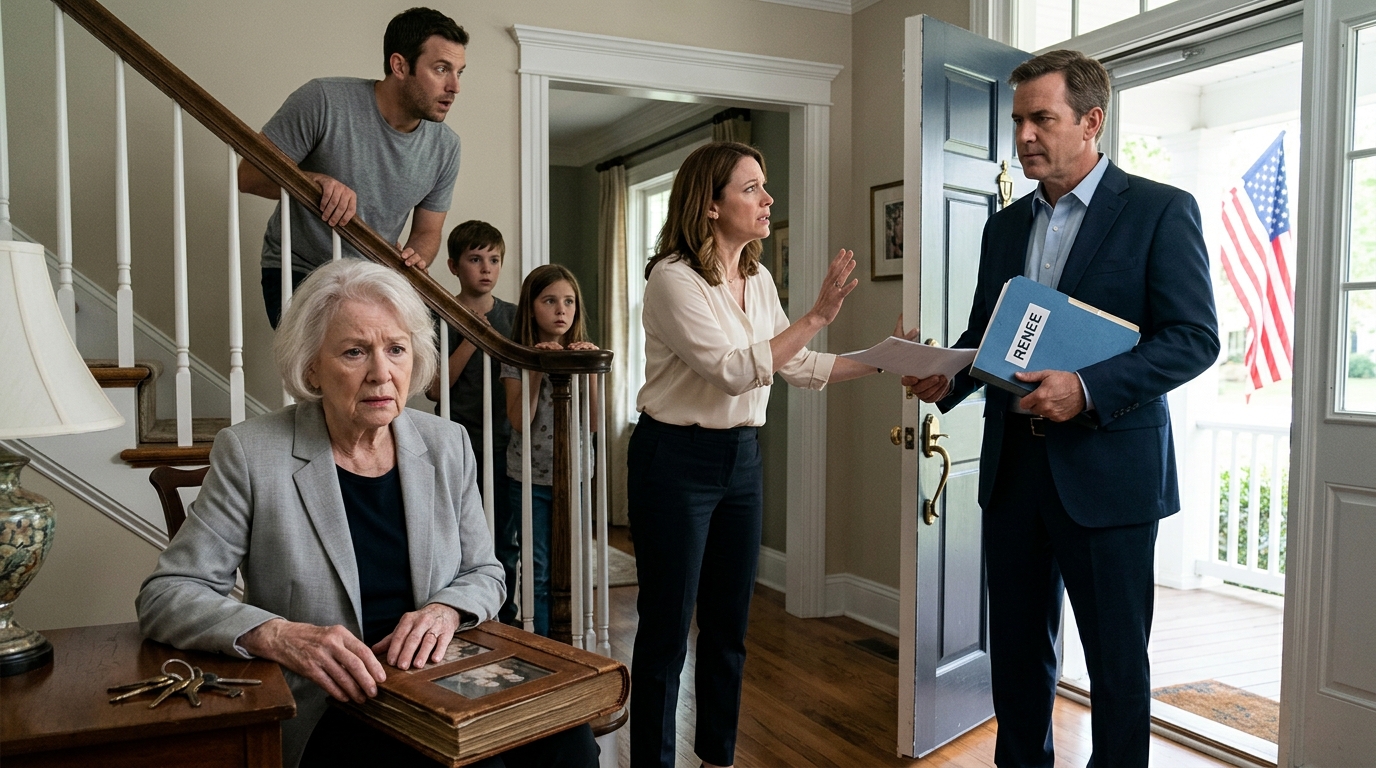
Then the doorbell rang.
Daniel came down the stairs barefoot.
Renee went still in a way I had never seen before.
On the porch stood a man in a navy suit with a folder that had her name typed across the tab.
When he lifted it, the top page slid forward.
Renee’s offer.
Her full name.
The house address.
7:04 a.m.
Financing contingency.
Seller credit request.
Personal letter attached.
Then came the rejection notice.
The house had already closed to a clean cash buyer through a private trust.
The trust used my maiden name.
Renee reached for the paper and missed.
She sat down hard on the bottom step, one heel scraping the wood.
Daniel gripped the banister.
“What name did you use?” he asked me.
I moved my hand off the key.
“The one I had before I became your mother,” I said.
Nobody spoke.
The hallway felt too bright.
The little American flag by the porch rail moved in the morning air behind the courier’s shoulder.
My grandson appeared at the top of the hall.
My granddaughter stood behind him with one hand over her mouth.
Renee looked from the rejection notice to me and tried to recover the version of herself that always knew what to say.
“Margaret,” she began, “we were going to talk to you about that house.”
“No,” I said. “You were going to talk around me about it.”
Daniel flinched.
It was small, but I saw it.
Mothers see the whole storm in one twitch of a child’s face, even when the child is fifty years old.
He said, “Why didn’t you tell me?”
I almost laughed.
Not because it was funny.
Because that question was a room with no furniture in it.
“You asked me to leave before you knew I had anything to offer,” I said. “I decided to believe you the first time.”
Renee stood up too fast.
“That is unfair.”
I looked at her for a long moment.
The woman who had counted my groceries.
The woman who had called my bedroom a guest room.
The woman who had put in an offer on a house while smiling at me over breakfast.
“What part?” I asked.
She did not answer.
The courier cleared his throat, embarrassed to be standing inside a family wound with a folder in his hand.
I thanked him.
I signed the receipt.
Then I shut the door.
Daniel followed me into the kitchen.
Renee stayed by the stairs with the folder in both hands, reading the rejection notice over and over as if the words might rearrange themselves out of pity.
My son looked older than he had at dinner.
“Mom,” he said, “I didn’t mean it like that.”
That sentence has carried many weak men through many locked doors.
“I think you did,” I said. “And maybe you regretted it once you thought I had money. But that is not the same as not meaning it.”
He rubbed both hands over his face.
“I was under pressure.”
“So was I.”
“You never said anything.”
“I was living in your guest room, Daniel. I learned not to take up space.”
That finally landed.
I saw it.
Not all at once.
Not cleanly.
But it landed somewhere behind his eyes.
For a moment he looked less like the man who had asked me to move out and more like the boy who used to run into my kitchen with scraped knees, trusting I would know what to do.
I wanted to comfort that boy.
I did not comfort the man.
That is the hard part of getting your dignity back.
You have to stop rescuing people from the consequences of how they treated you.
I packed that day.
Not everything.
Just what mattered.
My Bible.
Harold’s photo.
My good cardigan.
The tea tin.
The three albums.
The small ceramic dish my granddaughter made in fourth grade.
Daniel stood in the doorway twice.
The first time, he said nothing.
The second time, he asked whether I needed help.
“No,” I said. “But thank you.”
Renee did not come upstairs until the suitcase was closed.
Her makeup was perfect again, which told me she had decided this was a negotiation.
“Margaret,” she said, “you know we love you.”
I looked at my suitcase.
Then at her.
“Love does not itemize utilities.”
Her face tightened.
Behind her, my granddaughter made a small sound.
Not a sob.
Not exactly.
More like somebody hearing the truth and not knowing where to put it.
I walked past Renee and stopped by the stairs.
My grandson was sitting on the landing.
He would not look at me.
“Grandma,” he said, “are you mad at us?”
That was the only question that hurt.
I sat down beside him, careful with my knees.
“No, sweetheart,” I said. “Adults can make a house feel unsafe without children meaning to.”
His eyes filled.
My granddaughter came over and leaned against my shoulder.
For the first time in months, nobody corrected the moment.
Nobody rushed it.
Nobody turned it into a lesson about manners.
Daniel watched from the bottom of the stairs with his hand over his mouth.
I left before dinner.
No argument.
No performance.
No slammed door.
The SUV Patricia had arranged waited in the driveway because she believed dignity sometimes needed logistics.
As we pulled away, I saw Renee in the front window, still holding the folder.
Daniel stood behind her.
Neither of them waved.
At my new house, the porch faced east.
The first morning, I made tea before sunrise and set a second cup beside Harold’s picture.
The floorboards warmed slowly under my slippers.
The sun came through the sunroom windows like it had been waiting for me.
For a long time, I did nothing.
That may sound small.
It was not.
For two years, I had been useful before I was awake.
That morning, nobody needed a ride.
Nobody needed a signature.
Nobody needed me quiet.
Three days later, Daniel came by.
He did not bring Renee.
He stood on the porch with a paper coffee cup in each hand, looking at the wide boards and the little flag near the rail and the chair I had already placed in the sun.
“I brought tea,” he said.
“It’s coffee,” I said.
He looked down at the cups.
Then he laughed once, and it broke in the middle.
“I don’t know how to do this,” he admitted.
That was the first honest thing he had said in weeks.
I let him sit.
I did not let him inside right away.
We talked on the porch, where morning light makes excuses harder to hide.
He apologized.
Not perfectly.
Not dramatically.
But he said the words without asking me to make them easier.
He said he had let Renee speak about me like I was an expense.
He said he had wanted his house back and had been too ashamed to say it kindly.
He said he had forgotten that I had given up my own home because he asked me to trust him.
That was the sentence that mattered.
Trust.
Not money.
Not the house.
Trust.
I told him I loved him.
I also told him he would not manage my accounts, my home, my schedule, or my guilt.
He nodded.
His eyes were red.
“Did I lose you?” he asked.
“No,” I said. “But you lost the right to decide where I belong.”
That took the rest of the air out of him.
Good.
Some truths should.
Renee wrote me a note a week later.
It was neat, careful, and too polished.
She said she had been stressed.
She said she had never meant to make me feel unwelcome.
She did not mention the groceries.
She did not mention the utilities.
She did not mention the guest room.
I folded the note and put it in a drawer.
Not because I forgave it.
Because I did not need to keep rereading it to know what it was.
The grandchildren came over the next Saturday.
We baked biscuits badly.
My grandson burned the bottoms.
My granddaughter put too much flour on the counter.
I let the mess stay there longer than Renee ever would have.
When Daniel arrived to pick them up, he stood in my kitchen and saw the flour, the warm pan, the open windows, and the three plates in the sink.
He looked at me like he finally understood something simple.
A home is not the place where you are allowed to sleep.
It is the place where your presence does not need a defense.
People do not always throw you out with a suitcase.
Sometimes they make you useful until they can call your usefulness dependency.
Sometimes they ask you when you are finally leaving while you still have a dinner roll in your hand.
And sometimes, if you are very lucky and very quiet and very tired of being treated like furniture, you get to answer without raising your voice.
I bought the house.
I kept my name.
And when my son asked where I belonged, I let the key answer first.