A Soldier Returned With Five Children And A Funeral Secret.
My name is Savannah Cole, and for ten years I let the Whitmore family believe they had buried me while I was still alive.
Not physically, of course.
I was alive enough to serve my country, raise five children, sign school forms, braid hair before dawn, sit through fevers, field trips, nightmares, and birthday breakfasts where one child always wanted pancakes shaped like stars.

But in Georgia, among the white-columned houses and country club verandas where the Whitmore name still opened doors, I had become something else.
A mistake.
A woman Grant Whitmore had been wise to leave.
A scandal that proved the right family could survive anything as long as it controlled the story first.
For ten years, I did not correct them.
At first, I was too young and too exhausted to fight a war on two fronts.
I was twenty-four, newly divorced, pregnant, humiliated, and standing in a rented apartment with three boxes of clothes, a packet of medical papers, and a silence inside me that felt bigger than grief.
Grant had signed the divorce papers fast.
Too fast.
He did not give me ten full minutes to defend myself before he looked at the photographs, the hotel receipt, the signed statement, and decided he knew enough.
I remember the exact room where he ended us.
His mother’s sitting room.
Cream walls.
Blue porcelain lamps.
A silver tray of untouched tea sweating in the July heat because the air conditioner had gone weak that afternoon.
Vanessa Hale sat near the window with her ankles crossed, her pearl earrings catching light every time she tilted her head.
She did not speak much.
She did not have to.
The cruelest people in a room are often the ones who have already arranged for someone else to do the talking.
Grant held the hotel folio in his hand and said my name like it was evidence.
“Savannah.”
That was all.
Just my name, lowered into disappointment.
I told him I had never been at that hotel.
I told him the signature was wrong.
I told him I had been sick that morning, home alone, terrified because I had just taken a pregnancy test and watched the second line appear so faintly I had to stand under the bathroom light to believe it.
He looked at me then.
For one second, I thought the truth had reached him.
Then his mother said, “Grant, don’t let her do this to you.”
And the door closed inside his face.
The Whitmores were not loud people.
They did not scream when they destroyed you.
They folded napkins, lowered their voices, used words like dignity, reputation, unfortunate, and necessary.
By the time I left that house, my marriage was already being rewritten in rooms I would never enter again.
Savannah had been unfaithful.
Savannah had embarrassed Grant.
Savannah had accepted the settlement and disappeared.
That last part was nearly true.
I did disappear.
I enlisted formally, finished the training I had postponed for marriage, and let the Army give me a schedule when my heart could not give me one.
I learned to stand inspection while nausea rolled through me.
I learned how to fold a uniform jacket over a belly that grew faster than my courage.
When the ultrasound technician went quiet, then smiled in a stunned little way, I knew something had changed before she said it.
“There are five heartbeats.”
Five.
Ethan came first, furious and strong.
Noah followed with a cry so thin it frightened me.
Luke needed help breathing.
Rose arrived with one tiny fist pressed against her cheek.
Emma was last, the smallest, the one I kept checking because I was afraid the world might take her before I had learned her face.
They were born early, as everyone expected.
I spent weeks moving between incubators under fluorescent lights that never seemed to turn off.
My body ached.
My hands cracked from hospital soap.
My hair fell out in clumps from stress and hormones and fear.
But they lived.
All five of them lived.
And every day they looked more like their father.
At first, that hurt so badly I could barely breathe.
Ethan had Grant’s jaw.
Noah had his eyes.
Luke frowned the same way when concentrating.
Rose had the same left dimple that appeared only when she tried not to smile.
Emma slept with one hand over her head exactly the way Grant used to after late nights at the office.
I could have written to him.
I know that.
People love simple questions when they do not have to survive the answers.
Why didn’t you tell him?
Why didn’t you fight?
Why didn’t you march back with the babies and demand justice?
Because I had been called a liar by the man who promised to know me best.
Because the Whitmore lawyers sent one formal letter after the divorce warning me not to contact Grant directly.
Because Vanessa’s false hotel evidence was still sitting in a file somewhere like a loaded weapon.
Because five premature babies needed milk, medication schedules, specialist appointments, and a mother who did not spend her nights begging a rich family to believe her.
So I built a life without them.
I kept records.
That was the soldier in me before I even had the rank to prove it.
Every hospital form.
Every birth certificate.
Every pediatric genetics note where some doctor wrote paternal resemblance unknown because I refused to list a father who had already abandoned the truth.
Every certified copy of the divorce decree.
Every letter from the Whitmore attorney.
Every piece of paper became part of a box I told myself I would never open unless my children asked.
Then William Whitmore wrote to me.
It was three years after the divorce.
I had been stationed two states away, sleep-deprived and living in base housing with five toddlers who could dismantle a room in twelve minutes.
The envelope came through my old Army post office box.
Savannah, he wrote, I do not know where life has taken you, and I do not expect a reply. I only wanted to say I am sorry for the way silence can become cruelty when a family chooses comfort over courage.
He did not say he believed me.
He did not say he knew.
But he wrote one line that I folded into my Bible and carried through every move after that.
You deserved better from all of us.
William Whitmore had not saved me.
He had not defended me loudly when it mattered.
But he had looked ashamed on the day I left.
Sometimes, when everyone else throws stones, the person who merely lowers his hand is not innocent.
But he is also not the same as the ones who aimed.
I decided then that if my children ever met any Whitmore, it would be him.
Life did not make that easy.
Years passed.
Grant did not call.
Vanessa Hale became a permanent presence in the photos my old friends sometimes sent without thinking.
Charity galas.
Country club dinners.
Foundation events.
Her hand on Grant’s sleeve.
Her pearls at her throat.
Her smile polished enough to pass for innocence.
I never showed the photos to the children.
When they asked about their father, I told the truth carefully.
“He is alive.”
“He doesn’t know you.”
“One day, when you are older, I will tell you more.”
Ethan hated that answer first.
He was the child who needed doors either open or closed.
Noah asked questions quietly, usually at bedtime.
Luke pretended not to care and then drew family trees at school with empty spaces he colored blue.
Rose wanted to know if their grandfather liked dogs.
Emma once asked if people could miss someone they had never met.
I told her yes.
Then William died.
The obituary appeared on a Tuesday morning while I was drinking coffee from a chipped mug and signing a permission slip for Rose’s class trip.
William Ashford Whitmore, beloved father, grandfather, civic leader, and friend.
Grandfather.
I stared at that word for a long time.
It should have included five more names.
The funeral was set for Saturday at the family cemetery on the Whitmore property.
I did not decide quickly.
I spent two nights walking through the house after the children slept, past backpacks, sneakers, half-finished science projects, and the laundry basket that was always full no matter how many loads I did.
On the third night, Ethan found me at the kitchen table with William’s old letter, the obituary, and the box of documents open in front of me.
He did not touch anything.
He only said, “Is that him?”
I nodded.
“Our grandfather?”
“Yes.”
“Did he know about us?”
That question was the blade I had been carrying for ten years.
“No,” I said.
Ethan swallowed hard.
“Can we go?”
The other four heard everything from the hallway.
Children are not quiet when they spy, but they are very committed.
By breakfast, all five wanted to go.
Not because they understood inheritance or reputation or the old hotel lie.
They wanted to stand somewhere real.
They wanted a grave.
They wanted proof that half of their blood had not been a story I made up because I was sad.
So I prepared.
Not emotionally.
There is no preparation for walking back into a place where people once watched you bleed and called the stain your fault.
I prepared the way I had learned to prepare for everything else.
Methodically.
I requested updated certified copies of the birth records.
I printed the paternity reports I had finally ordered when the children turned ten and began asking harder questions.
I included the old hotel folio with the false signature.
I included the notarized statement from the former clerk, a woman named Darlene Pierce, who had found me nine years after the divorce because guilt had eaten through whatever Vanessa paid her.
Darlene’s statement was plain.
Vanessa Hale had come to the Whitmore Heritage Hotel with a registration card already filled out.
Darlene had been asked to enter it into the system as if I had checked in.
A man Vanessa identified only as a family associate had delivered cash in an envelope.
Darlene signed the statement in front of a notary at 4:18 p.m. on March 12, with her hands shaking so badly the notary asked if she needed water.
I put everything in a manila envelope.
Then I ironed my dress uniform.
On Saturday morning, the children dressed in black.
Ethan buttoned Noah’s collar because Noah’s fingers were trembling.
Luke kept asking if he should bring flowers.
Rose chose a small white ribbon for her hair, then took it out because she thought it looked too happy.
Emma put William’s copied obituary in her coat pocket.
The drive to the Whitmore property took almost two hours.
The closer we got, the quieter the SUV became.
Georgia rolled past us in gray fields, wet fences, and old oak trees dripping from last night’s rain.
When the church bells began to toll in the distance, Rose reached across the seat and found Emma’s hand.
I did not cry.
Not then.
My jaw locked too hard for tears.
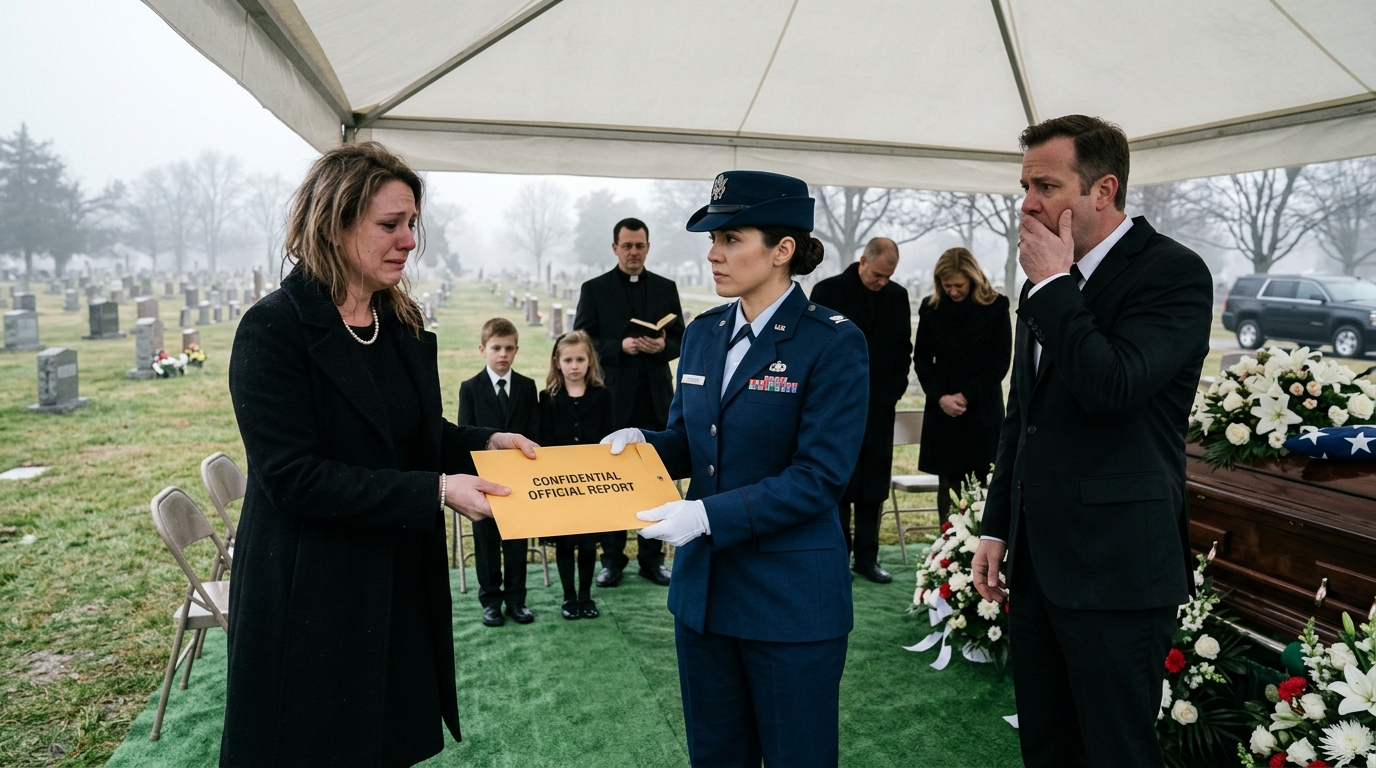
I walked into my ex-husband’s family funeral with five children at my side, and the whispers started before we even reached the grave, but the moment he finally looked at them and saw his own face reflected in all five, the woman who helped destroy my marriage turned so pale I knew the past was about to collapse in front of everyone.
That is exactly what happened.
The SUV stopped near the gravel path.
I stepped out first.
The air smelled like lilies, wet grass, and old money pretending grief made everyone equal.
My medals caught the dull morning light.
For a few seconds, people only stared at the uniform.
Then the children got out.
One door.
Then another.
Then another.
Five children in black, standing beside me with the Whitmore face written across them so clearly that even strangers would have understood.
The whispers began at once.
I heard numbers before I heard names.
“Five?”
“Are those…”
“Look at the oldest one.”
“My God, he looks like Grant.”
I kept walking.
The children walked with me.
My right hand held the envelope.
My left held Rose’s hand.
William’s coffin waited beside the grave under a white tent.
Grant stood near it with the pallbearers, his black tie loosened, his face drawn with grief.
For one strange second, I saw the man I had loved before pride, fear, and manipulation hollowed him out.
Then Vanessa stepped into our path.
She had aged beautifully, which felt unfair until I saw her eyes.
The face was polished.
The eyes were not.
She recognized the children before Grant did.
That was how I knew.
She knew exactly what she had buried.
“Well,” she said, loud enough to perform for the mourners behind her, “I suppose the military doesn’t teach shame.”
Ethan’s fingers tightened around the seam of his jacket.
I did not look down at him because I knew if I saw his face, restraint might leave me.
“Move,” I said.
Vanessa smiled.
“Do you really expect people to believe this little parade happened by accident?”
“They came to say goodbye.”
“To a man who was not their family.”
Rose stepped forward before I could stop her.
She was small for ten, with Grant’s dimple and my stubborn chin.
“He was our grandfather,” she said.
That sentence did what no accusation could have done.
It made the whole cemetery hear the children as children, not evidence.
A woman near the second row gasped.
The minister’s Bible lowered.
A pallbearer stared at the coffin handle like brass had suddenly become fascinating.
Nobody moved.
Then Grant turned.
He looked at Ethan first.
I saw the recognition begin like a wound opening.
Then Noah.
Luke.
Rose.
Emma.
Each child struck him separately.
By the time his eyes returned to me, he was no longer only grieving his father.
He was beginning to grieve ten years.
“Savannah,” he said.
His voice sounded scraped raw.
“What is this?”
Vanessa reached for Rose.
I caught her wrist before her fingers touched my daughter.
I did not twist.
I did not shove.
I only held her there long enough for every person under that tent to see who had moved first.
“Do not put your hands on my daughter,” I said.
Her pulse jumped under my glove.
Grant saw that too.
His eyes dropped to the envelope in my hand.
Vanessa whispered, “Savannah, don’t.”
And just like that, the truth announced itself before I did.
Grant looked at her.
Not at me.
At her.
“What did you do?” he asked.
No one answered.
So I opened the envelope.
I did not throw papers.
I did not shout.
I slid out the first page and held it where Grant could see the laboratory header, the case number, his name, and the five matching results.
His face changed in a way I will never forget.
People imagine shock as wide eyes and open mouths.
Real shock is often quieter.
It is the body realizing before the soul agrees.
Grant’s shoulders dropped first.
Then his hand rose to his mouth.
Then he looked at Ethan again, and his eyes filled.
“Five?” he whispered.
“Five,” I said.
Vanessa tried to recover.
“Anyone can print papers, Grant. This is obscene. She brought props to your father’s funeral.”
I slid out the hotel folio.
The old lie looked small in daylight.
One page.
One forged signature.
One room number I had never entered.
One check-in time that placed me at the Whitmore Heritage Hotel when I had actually been at a clinic confirming a pregnancy I had planned to tell my husband about that night.
“This,” I said, “is what you used.”
Vanessa’s mouth tightened.
“I have no idea what you’re talking about.”
I took out the photograph next.
It showed Vanessa in the hotel lobby ten years earlier, standing at the front desk beside the clerk, her hand resting on the registration card.
The timestamp sat in the corner.
The same date.
The same hour.
Grant reached for the picture, then stopped as if he was afraid it might burn him.
William’s sister Margaret pushed forward through the mourners.
She had always been the sharp one, the woman who remembered who sat where at dinners and which cousin lied about college money.
She took one look at the photo and covered her mouth.
“Vanessa,” she whispered, “tell me that is not your handwriting.”
Vanessa said nothing.
That silence was the first confession.
Grant turned toward her fully.
“You told me Savannah checked into that hotel with another man.”
“Because she did.”
The answer came too fast.
Too practiced.
I almost pitied her for that.
Almost.
I handed Grant the notarized statement.
His fingers shook when he unfolded it.
He read Darlene Pierce’s name.
He read the date.
He read the part about the cash envelope.
He read the line where Darlene admitted Vanessa had supplied the registration card before I was ever accused of anything.
Grant sat down hard on one of the folding chairs.
No one tried to help him.
The great Whitmore family, so fluent in appearances, did not know what appearance to choose.
The minister looked at the coffin.
The pallbearers looked at the grass.
Vanessa looked at escape.
Ethan stepped slightly in front of his siblings.
That nearly broke me.
A ten-year-old child should not feel responsible for protecting four other children from adult sins committed before he was born.
Grant saw the movement.
His face crumpled.
“Savannah,” he said, “you were pregnant.”
“Yes.”
“When I divorced you?”
“Yes.”
“With them?”
I looked at our children.
“With them.”
For the first time in ten years, there was no room for Vanessa’s version of events.
Grant turned on her.
“Did you know?”
She lifted her chin.
“Know what?”
“That she was pregnant.”
Vanessa’s eyes flicked toward me.
It lasted less than a second.
But everyone saw it.
Margaret made a sound like she had been struck.
Grant stood.
“Did you know?”
Vanessa’s polished face finally cracked.
“She would have ruined you.”
The words came out low, furious, and naked.
There are moments when evil stops wearing perfume.
That was one of them.
The cemetery seemed to inhale.
Vanessa looked around as if she could gather the words back from the air.
She could not.
Grant staggered one step away from her.
“You knew,” he said.
“I knew she was trying to trap you.”
“They are my children.”
“They are complications,” Vanessa snapped.
Emma flinched.
I moved before I thought.
One step.
Enough to put my body between Vanessa and my children.
Grant saw Emma’s face.
Something inside him changed then, not into forgiveness, not into redemption, but into the first honest horror I had ever seen from him.
He looked at Vanessa as if she had become a stranger while wearing a familiar dress.
“My father died without knowing he had five grandchildren,” he said.
Vanessa’s voice dropped.
“Your father was weak. He would have believed anything she said.”
That was when Margaret slapped Vanessa.
It was not a dramatic slap.
It was old, controlled, and final.
The sound cracked across the tent.
“Do not speak of my brother,” Margaret said, “while standing beside his grave.”
No one corrected her.
No one defended Vanessa.
The silence that had protected her for ten years finally chose another target.
Grant turned back to me.
His eyes were wet now.
“Why didn’t you tell me?”
I had imagined that question for a decade.
In my angriest versions, I shouted.
In my weakest versions, I cried.
In the real moment, my voice came out calm.
“I did. You chose the hotel receipt.”
He closed his eyes.
That was the sentence that landed.
Not the DNA.
Not the photograph.
Not the statement.
That.
Because he remembered.
I saw it happen.
He remembered me standing in his mother’s sitting room, one hand against my stomach, asking him to listen.
He remembered turning away.
For all Vanessa had done, Grant still had to live with the one decision only he had made.
The funeral did not continue after that.
Not really.
The minister finished the service in a voice that trembled around the edges.
William was lowered into the ground while his family stood fractured around the grave.
My children each placed a white flower on the coffin.
Rose whispered, “Goodbye, Grandpa.”
Grant heard it.
He covered his mouth and turned away.
I did not comfort him.
Some grief must be allowed to arrive without an audience.
When the service ended, Vanessa tried to leave through the side path.
Margaret stopped her.
“No,” she said. “You will stay until Grant decides whether he wants security or police.”
Vanessa laughed once.
It was a ruined sound.
“Police? For what? Embarrassing a woman who disappeared?”
I looked at the envelope.
“Forgery. Fraud. Defamation. Conspiracy, if the attorney wants to get ambitious.”
Grant’s head turned.
“Attorney?”
“I did not come unprepared.”
That was when a black sedan pulled up near the cemetery gate.
A woman in a charcoal suit stepped out carrying a leather folder.
Her name was Elaine Porter, and she had spent six weeks reviewing my documents before I ever agreed to attend the funeral.
I had not brought her to make a scene.
I brought her because I knew the Whitmores.
They respected grief.
They respected blood.
But they respected legal letterhead most of all.
Elaine did not enter the tent.
She waited by the gate, visible enough for Vanessa to understand that the morning had moved beyond gossip.
Grant saw her.
Then he looked back at me.
“You knew this might happen.”
“I knew Vanessa would not let my children walk to their grandfather’s grave without trying to humiliate them.”
He swallowed.
“And me?”
“I did not know what you would do. That was the problem ten years ago too.”
He took that without argument.
It was the first decent thing he had done all morning.
The legal aftermath did not unfold like a movie.
There was no instant arrest beside the grave.
No screaming confession signed on the hood of a patrol car.
Real consequences are slower.
They arrive through certified mail, depositions, quiet interviews, and people who suddenly cannot remember things they once said with confidence.
Elaine filed the first civil action within three weeks.
Darlene Pierce testified under oath.
The hotel records, once thought lost, had been archived badly but not destroyed.
A maintenance invoice placed Vanessa at the hotel that morning.
An old security backup produced three still images, grainy but clear enough.
Vanessa at the desk.
Vanessa beside Darlene.
Vanessa leaving with a man who had worked for the Whitmore family attorney at the time.
That attorney retired very suddenly once Elaine requested his communications from the week of my divorce.
Grant submitted to independent paternity testing.
The results did not change.
Five children.
His children.
Ethan, Noah, Luke, Rose, and Emma.
I wish I could say fatherhood transformed him overnight.
It did not.
He was awkward.
Ashamed.
Sometimes too eager.
Sometimes silent because every question from the children carried a decade he could not answer without indicting himself.
Ethan was hardest on him.
Good.
Children are not bridges adults get to walk across without asking permission.
Noah wanted facts.
Luke wanted to know if Grant liked baseball.
Rose wanted to know why he had not looked for them.
Emma asked once, softly, whether he would leave again if someone lied.
Grant cried then.
Not loudly.
But enough.
He told her, “No. And I am sorry I did the first time.”
I watched her decide whether to believe him.
I did not push.
The court eventually recognized the paternity, amended the records, and ordered support retroactive as far as the law allowed.
Grant offered more than the court required.
I accepted what belonged to the children and refused what felt like guilt dressed as generosity.
Vanessa settled the civil claims after her own messages surfaced.
One text to Darlene said, He’ll believe paper before he’ll believe tears.
That line followed her everywhere.
It cost her the foundation board.
It cost her invitations.
It cost her the version of herself she had spent ten years selling.
But the story was never really about Vanessa losing face.
It was about five children gaining names.
It was about William Whitmore’s grave becoming the place where a family lie finally ran out of breath.
It was about a soldier who returned in uniform not because she wanted war, but because she had already survived one.
Months later, we went back to the cemetery without a crowd.
Just me, the children, and Grant standing several feet away because he had learned not to assume closeness.
The grass had grown over William’s grave.
Rose brought daisies.
Emma brought the folded obituary she had carried that first day.
Ethan stood with his hands in his pockets, studying the headstone.
After a while, he said, “He would have wanted to know us, right?”
Grant answered before I could.
“Yes,” he said. “He would have loved you.”
Ethan looked at him.
“Then don’t waste what he didn’t get.”
Grant nodded.
He did not defend himself.
He did not ask for comfort.
He only nodded, and for Ethan, that was enough for that day.
Not forever.
Just that day.
Healing is not a door that opens once.
It is a hallway.
Some days my children walk farther down it.
Some days they stop and look back.
Some days I do too.
I still have William’s letter in my Bible.
I still have the old envelope, though now the papers inside sit in proper files where they belong.
And I still remember the sound of the cemetery when Rose said he was our grandfather.
That was the moment the Whitmore family learned what I had known for ten years.
Truth does not disappear because powerful people refuse to look at it.
Sometimes it grows up.
Sometimes it puts on black funeral clothes.
Sometimes it walks beside its mother through a cemetery under a gray Georgia sky, carrying the same face as the man who once chose a lie.