For four years, I sent my parents $1,500 every month so they wouldn’t lose their Denver home with the mountain view, while I lived in a basement apartment and drove a car with the check-engine light glowing. I told myself I was being a good daughter.
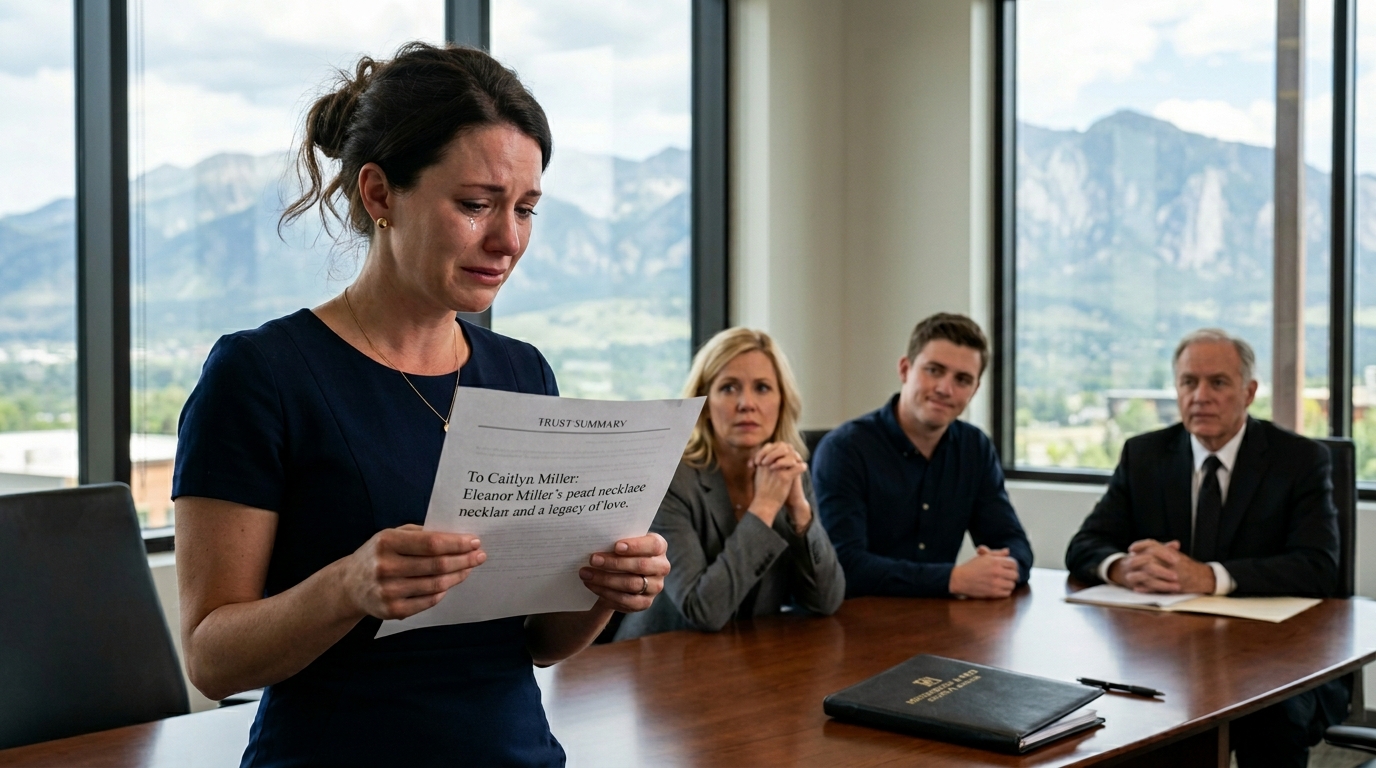
Thirty days after I walked out of Henderson & Pike Family Law with my inheritance reduced to a pearl necklace and a sentence about love, my phone lit up at 11:51 p.m. like a billing notice from the universe.
For a full second, I simply stared at the screen from across the dark bedroom. The apartment was quiet, the kind of quiet basement apartments have when the world above them has gone to sleep but the pipes, furnace, and old wooden joists keep murmuring like they know secrets. Outside my narrow window, a car rolled past slowly enough for its headlights to slide across the ceiling. My room flashed white, then dimmed again. The phone buzzed once more on the crate I used as a nightstand because I had never gotten around to buying a real one.
The message was from my mother.
Monica Miller.
Mortgage is due. Transfer the money.
No hello.
No Are you awake?
No We haven’t heard from you in a month.
No Are you okay after that meeting where we told you your brother would inherit the house you spent four years paying for?
Just mortgage is due.
Transfer the money.
I lay there for a moment in my thrift-store bed frame, beneath a quilt my grandmother had made before arthritis ruined her hands, and waited for my heart to do what it used to do. Race. Clench. Panic. Begin immediately searching for solutions. I waited for the old reflex, the one that had governed my adult life for so long that I used to mistake it for character.
It did not come.
My pulse stayed steady.
My breathing did not change.
The message looked less like an emotional emergency than an incorrect prescription request in the pharmacy system. Dangerous if filled. Harmless if rejected.
I reached for the phone and typed with the same precise calm I used when denying suspicious opioid refills at work.
Forward the bill to the owner. That isn’t me.
Then I set the phone face down and listened to the building settle around me.
The reply did not come right away.
For fourteen seconds, there was silence.
And in those fourteen seconds, I understood that my family had never truly believed I would stop paying. They had mistaken my endurance for consent. They had mistaken my competence for infinite capacity. They had mistaken my love for a direct deposit.
To understand why those words—That isn’t me—split my family open, you need to understand the economics of the Miller household.
Not the finances.
The economics.
There is a difference.
Finances are numbers. Income, debt, mortgage payments, investments, refinancing terms, late fees. Economics are about incentives. Scarcity. Value. Exchange. What gets rewarded. What gets punished. What a system teaches its members to keep doing because it benefits someone else.
Our family system was built on one invisible currency: my capability.
I was Caitlyn Miller, thirty-three years old, senior pharmacist at a busy hospital outpatient pharmacy outside Denver. I had worked for years to become that person. Undergraduate loans, pharmacy school loans, residencies, night shifts, exams, internships, missed weddings, missed weekends, missed everything ordinary people seemed to collect without effort. By the time I finally started earning real money, I was almost thirty and so tired that my success felt less like a celebration than a discharge summary after prolonged illness.
My parents were proud in public.
That mattered, because Timothy and Monica Miller loved public pride. They loved telling people at church that their daughter was a pharmacist. They loved saying, “Caitlyn works in healthcare,” with the particular tone people use when they want others to know their child is respectable. My father would tell his friends I had a doctorate, though technically it was a PharmD, and he never understood the distinction. My mother would beam when neighbors asked about me and say, “She was always the responsible one.”
Responsible.
That was the first word in the family ledger beside my name.
Responsible meant I answered calls.
Responsible meant I paid bills.
Responsible meant I did not ask for much.
Responsible meant everyone assumed I could handle whatever they needed because I always had.
Four years earlier, my father made what he called “a series of unfortunate decisions,” which was his way of saying he gambled almost his entire pension on a tech startup pitched by a man he had met at a golf charity event. The man wore expensive shoes and said words like platform, disruption, scalable ecosystem, and early liquidity. Dad heard opportunity. I heard, much later, fraud with better branding.
The company evaporated in eight months.
No product. No return. No lawsuit worth pursuing because the money had been routed through contracts my father had not read carefully enough. By the time he admitted what had happened, he and my mother were three months behind on their mortgage. Their house—42 Evergreen Terrace, four bedrooms, wraparound porch, enormous windows facing the Rockies—was days from a foreclosure notice.
The house was their forever home.
That was what they called it. Their retirement dream. Their reward for decades of working, saving, raising children, enduring winters, and waiting for life to become beautiful. It sat in one of those Denver suburbs where every house had stone accents, decorative lanterns, and a view people pretended not to price into every conversation. Their porch looked toward the mountains. At sunset, the peaks turned rose-gold. My mother said the view made her feel close to God.
My basement apartment had one narrow window at sidewalk level. If I craned my neck from the kitchen table, I could see the retaining wall and the tires of cars parked on the street above. In winter, snowplow slush froze against the glass. In spring, water seeped under the door if rain came too hard. My apartment smelled faintly of laundry detergent, old carpet, and the dampness landlords call “seasonal.”
When my parents told me they were going to lose the house, I was twenty-nine, newly promoted, still carrying enough student debt to make my stomach tighten whenever I opened my loan portal.
I did not hesitate.
That is the part I still examine.
There was no dramatic internal struggle. No spreadsheet first. No What about my future? I saw my mother crying into a napkin at their kitchen table and my father staring at his hands, and I became the answer because that was what I had been trained to be.
“How much?” I asked.
Dad looked up.
“What?”
“How much do you need to stay current?”
My mother whispered, “Caitlyn, honey, we can’t ask you to—”
But she did not finish the sentence.
Because of course they could ask.
They had been asking me, in one form or another, my entire life.
The arrangement began as temporary. Fifteen hundred dollars a month to keep the mortgage current while Dad “restructured” his finances and got back on track. I set up automatic transfers from my checking account to theirs. I told myself it was duty. I told myself it was family. I told myself I was fortunate to be able to help.
IF YOU CAME FROM FACEBOOK, START FROM HERE!
That last sentence became my prison.
I lived carefully. More than carefully. I lived like a person preparing for winter without knowing how long winter would last. I drove a ten-year-old Honda with a check engine light that appeared whenever the car felt dramatic. I packed lunches for work—rice bowls, leftovers, tuna sandwiches, yogurt cups purchased in bulk. I bought shoes on clearance and wore them past the point where they supported my feet through twelve-hour shifts. I said no to trips, dinners, concerts, and housewarming parties because every month fifteen hundred dollars left my account before I could decide what I wanted my life to be.
My parents kept their mountain view.
I kept my retaining wall.
Then there was Zachary.
My younger brother was thirty-one, though within the family economy he remained permanently twelve. Zachary was a dreamer, which is the word families use when unemployable sounds too honest. He had ideas. Always ideas. An app for micro-influencer scheduling. A subscription box for men who hated shopping. A crypto education platform. A coffee truck that never materialized beyond a logo he paid someone to design. He formed LLCs the way other people joined gyms in January. Lots of intention, very little follow-through.
He also gambled.
Not openly at first. In our family, Zachary did not have problems; he had stressors. He did not blow money; he took risks. He was not unemployed; he was between ventures. He was not unreliable; he was creative. My parents wrapped his failures in language soft enough that no one had to call them what they were.
When Zachary totaled his car after leaving a poker night at 2:00 a.m., Dad found money for a replacement.
When Zachary’s landlord threatened eviction, Mom “scraped together” rent.
When Zachary needed a new laptop for investor decks, my parents said he needed tools to succeed.
When I asked why he could not get a job while building his dreams, my mother sighed.
“Caitlyn, you don’t understand your brother. He’s sensitive.”
Sensitive.
Fragile.
Creative.
Misunderstood.
Those words bought Zachary everything my competence cost me.
I worked sixty-hour weeks in a pharmacy where one mistake could kill someone. I verified dosages, caught dangerous interactions, counseled patients, handled insurance rejections, managed inventory, trained junior staff, and carried the weight of other people’s health in my hands. When I came home, my back ached, my feet burned, and I still opened my banking app to make sure my parents’ mortgage transfer had cleared.
Zachary floated.
And somehow floating was treated as vulnerability, while standing upright was treated as surplus.
It took me years to name the pathology: the curse of capability.
My parents did not neglect me because they hated me. That would have been simpler. They neglected me because I functioned. I had become the structural beam in the house of our family, load-bearing and invisible. Beams do not get thanked for holding ceilings. Nobody decorates them. Nobody asks whether they are tired. They are only noticed when they crack.
Zachary cracked constantly.
So he got attention.
I held.
So I got weight.
By the time we walked into the lawyer’s office, the arrangement had become so normalized that I did not think to question why I had been invited. My mother had called two weeks earlier and said they were updating their living trust.
“Given Zachary’s engagement,” she said.
I nearly laughed.
Zachary had met a woman named Elise in Las Vegas two months earlier. She was pregnant. He announced the engagement at my parents’ house over takeout barbecue, sliding an arm around her waist like he had personally invented commitment. Elise was twenty-six, pretty, visibly exhausted, and already looking at my brother with the wary hope of someone who knows the math is bad but wants the story to be good.
Mom cried when Zachary announced the baby.
Dad slapped him on the back.
I asked whether they had insurance.
The room went quiet.
Later, Mom told me I could be “cold.”
So when she mentioned the trust, I assumed they were planning for the baby. Maybe creating some safeguards. Maybe formalizing support for Zachary in a way that would finally put structure around the chaos. I came straight from a twelve-hour shift, wearing a navy work dress, compression socks hidden under low heels, and the kind of exhaustion that makes fluorescent lights feel personal.
Henderson & Pike was located in a professional building near a shopping plaza with an artisan bakery and a Pilates studio. The office smelled of lemon polish, paper, and the stale coffee attorneys offer clients because the coffee is not the point. The air-conditioning was set so cold my hands went numb.
Mr. Henderson was a small man in his sixties with silver hair and a tie printed with tiny blue diamonds. He sat behind a heavy desk with the trust documents stacked neatly before him. My parents sat opposite him holding hands. That should have warned me. Timothy and Monica Miller only held hands in public when they were preparing to present themselves as a united moral front.
Zachary sprawled in the chair beside them, scrolling on his phone.
He looked bored.
That should have warned me more.
Mr. Henderson cleared his throat.
“As you know, your parents wanted to update their living trust given Zachary’s recent engagement and the anticipated arrival of their grandchild.”
I nodded.
“That makes sense.”
My father looked out the window.
My mother studied her cuticles.
Mr. Henderson turned a page.
“The primary residence, located at 42 Evergreen Terrace, along with the remaining investment portfolio and the vintage watch collection, will transfer to the sole ownership of Zachary Miller upon the passing of Timothy and Monica Miller.”
For a moment, I heard only the hum of the air conditioner.
“I’m sorry,” I said. “Can you repeat that?”
Mr. Henderson’s eyes flicked toward my parents, then back to the page.
“The house and primary assets are designated for Zachary.”
I looked at Mom.
She did not look back.
Dad’s jaw tightened.
“And Caitlyn?” I asked.
Mr. Henderson turned another page, though he clearly knew the answer.
“To Caitlyn Miller, your parents leave Eleanor Miller’s pearl necklace and a legacy of love.”
A legacy of love.
The phrase hung in the room like perfume sprayed over garbage.
My grandmother’s pearl necklace was pretty, but old, scratched, and worth maybe three hundred dollars if someone on eBay felt sentimental. A legacy of love was not a legal asset. It was what people say when they have already decided you should accept nothing and feel guilty for naming it.
I stood.
The movement surprised everyone, including me. My legs felt shaky, but my voice did not.
“I have paid the mortgage on that house for four years.”
Mom finally looked up. “Caitlyn—”
“Every month. Fifteen hundred dollars. I paid the down payment on the refinance. I paid for the new roof last summer.”
Dad turned to me then, his face hard in a way I had rarely seen directed at me. It was the face of a man who had rehearsed righteousness because he knew the facts were ugly.
“Zachary has a family now,” he said. “He needs stability.”
I stared at him.
“And I don’t?”
“You have stability,” he said. “You have a career.”
“I have a basement apartment.”
“You’re strong, Katie.”
He had not called me Katie in years.
The nickname struck like manipulation wearing childhood clothes.
“You’re strong enough to buy your own house,” he continued. “Zachary isn’t.”
There it was.
The sentence that severed the artery.
You’re strong enough.
My competence was the weapon they used to disinherit me.
I turned slowly toward Zachary.
He finally looked up from his phone.
He did not look shocked.
He did not look guilty.
He looked smug.
Just slightly. A small curve at the corner of his mouth, quickly hidden, but not quickly enough. He had known. He had known the whole time that I was paying for his future. He had sat at dinners, watched me bring store-brand wine because I was budgeting, listened to our mother praise his latest “business concept,” and allowed me to fund the house he would inherit.
My brother did not steal from me in secret.
He let my parents do it in front of me and called it family.
“I see,” I said.
Mom reached for her purse. “Don’t be dramatic.”
The words snapped the final thread.
I picked up my bag.
“It’s just paper,” she said. “We’re still family.”
“No,” I said, walking to the door. “We’re not.”
I left before anyone could stop me.
Outside, the afternoon sun was blinding. Heat shimmered off the parking lot. Somewhere nearby, a woman laughed as she walked out of the bakery carrying a paper bag. The normal world continued, rude in its indifference.
I got into my Honda and sat with both hands on the steering wheel.
My phone buzzed once.
Mom: We should all calm down and talk later.
I put the phone in the cup holder and drove home without music.
The betrayal settled slowly. At first, shock acted like anesthetic. I could feel pressure but not pain. The facts lined themselves up clinically, as if I were reviewing a medication error. House left to Zachary. Mortgage paid by Caitlyn. Necklace to Caitlyn. Legacy of love. Strong enough. Zachary needs stability.
Then the meaning arrived.
I had not been helping preserve my parents’ home.
I had been paying for Zachary’s inheritance.
When I unlocked the door to my basement apartment, stale warm air greeted me. The apartment was dim because the small windows faced the retaining wall. I did not turn on the lights. I set my purse on the kitchen table, opened my laptop, and logged into my banking portal.
There it was.
Pending transfer.
$1,500.
Recipient: Timothy and Monica Miller joint checking.
Scheduled for the first of the month.
Three days away.
For four years, that transaction had been framed in my mind as duty, kindness, repayment for childhood, evidence that I was a good daughter. Looking at it now, I saw something different. Not a safety net. A chain.
I clicked the transaction.
A menu appeared.
Edit amount.
Change date.
Cancel series.
My finger hovered for one second.
In that second, a ledger opened inside me.
Not just financial. Emotional.
Item: Missing my friend Jenna’s wedding because Dad needed someone to drive him to physical therapy and Zachary was “too stressed” to help.
Cost: friendship.
Item: Eating peanut butter toast for dinner in January because I had covered my parents’ heating oil bill.
Cost: dignity.
Item: Driving a car with a check engine light while Zachary drove the newer car my father “found money” for.
Cost: safety.
Item: Listening to my mother tell church friends Zachary was “so full of potential” while saying I was “doing fine.”
Cost: self-worth.
Item: Believing if I paid enough, showed up enough, and asked for little enough, I would eventually be loved in a way that felt visible.
Cost: thirty-three years.
I clicked cancel series.
A confirmation box appeared.
Are you sure you want to cancel all future recurring payments to Timothy and Monica Miller?
“Yes,” I whispered to the empty kitchen. “I’m sure.”
Confirm.
The pending transfer vanished.
Just like that, four years of obligation evaporated into digital silence.
I closed the laptop, walked to the sink, and poured a glass of water.
It tasted like freedom.
For thirty days, I conducted an experiment.
I did not block their numbers. I did not send explanations. I did not post vague quotes online or tell relatives what happened. I simply withdrew my service and waited to see if anyone noticed me rather than my money.
Day one passed.
Then day five.
Day fourteen.
Day twenty-one.
The silence in my apartment was not empty. It was data.
I went to work. I verified prescriptions. I counseled a woman on warfarin interactions. I called an insurance company and spent forty minutes explaining why a patient’s inhaler was not optional. I ordered inventory, trained a new hire, checked controlled substance counts, and smiled at patients who never knew I was quietly watching my family fail the simplest possible test.
Would they call their daughter when money was not involved?
They did not.
Not Mom.
Not Dad.
Not Zachary.
Not even a text from my mother saying, Are you still upset? Not even a manipulative invitation to dinner. Nothing.
I began to understand that if I had been a daughter to them, they would have noticed my absence. But I was not a daughter. I was a utility. Electricity. Internet. Water. You do not call the power company to ask whether it feels lonely. You call when the lights go out.
On November first at 11:51 p.m., the lights went out.
Mortgage is due. Transfer the money.
Forward the bill to the owner. That isn’t me.
Fourteen seconds later, my phone began to buzz.
Monica calling.
I let it go to voicemail.
Monica calling again.
Then Zachary.
What the hell? Mom is freaking out.
Mom texted.
Caitlyn, pick up. The bank sent a notice. If we don’t pay by the 5th, there’s a late fee. What are you playing at?
Zachary: You can’t just cut us off. That house is my future.
Mom: Your father’s blood pressure is up. Do you want him back in the hospital? Send the money tonight.
Zachary: You’re jealous. That’s what this is. You’re bitter because Mom and Dad know I need the house more.
Mom: This is not who you are. You’re a good daughter. Don’t punish us because your feelings got hurt.
I read the messages with the detachment of a forensic accountant reviewing a bankruptcy file.
No concern.
No curiosity.
No question about why I had stopped paying.
Only panic that the ATM had malfunctioned.
Zachary’s message told the whole truth: That house is my future.
Not Mom and Dad’s home.
Not family legacy.
Not shelter.
His future.
He saw a house he had not paid for as already belonging to him, and he was furious that the interest payments had stopped.
I did not respond.
Instead, I opened my laptop.
If they wanted this to be a transaction, I would treat it like one.
The first rule of any hostile takeover is due diligence.
I knew my parents were bad with money. That was the story I had been sold. Bad investment. Pension loss. Mortgage trouble. Temporary help. But the level of panic in their messages felt disproportionate. A missed mortgage payment triggers a late fee. It does not create an emotional five-alarm fire unless the margins are much thinner than anyone admitted.
I went to the county clerk’s online portal and typed in the address.
42 Evergreen Terrace.
The property records loaded quickly.
Original purchase.
Refinance in 2018—the one I knew about.
Roof permit.
Tax notices.
Then a document dated fourteen months earlier stopped me cold.
Instrument type: Deed of Trust.
Grantors: Timothy and Monica Miller.
Principal amount: $450,000.
I stared at the number.
The house was worth maybe $480,000 on a generous day. A $450,000 deed of trust meant they had stripped almost all the equity out. A cash-out refinance. A huge one.
Fourteen months ago.
I counted backward.
That was when Zachary’s latest startup died quietly. That was when he stopped asking me for smaller loans. That was when Dad suddenly said their finances were “stabilizing” and Mom bought new patio furniture. That was when Zachary began wearing Dad’s vintage Omega watch, saying Dad wanted him to have it early because “legacy shouldn’t wait.”
The truth arrived so hard I laughed.
A cold, sharp laugh that startled me in the dim room.
They had cannibalized the house.
They had drained the equity to bail out Zachary—gambling debts, business debts, investor threats, who knew which—and then left the empty shell to him in the trust. They had not given him a house. They had given him a liability dressed as inheritance.
And I had been servicing the debt.
My fifteen hundred a month was not preserving my parents’ home. It was paying the carrying cost of Zachary’s failures.
The golden child had been handed a grenade.
By canceling the transfer, I had pulled the pin.
I printed the deed of trust.
Then I printed my bank records, transfer history, the trust summary Mr. Henderson had given us, and my own spreadsheet of payments. I stacked them neatly in a folder.
I slept well that night.
The banging started at 7:03 Saturday morning.
Not knocking.
Banging.
The entitled pounding of people who believe their emergency outranks your door.
I was already awake, drinking coffee in pajama pants and an old pharmacy conference sweatshirt. I did not rush. I finished my coffee, rinsed the mug, dried it, and walked to the door.
Through the peephole, I saw my mother and Zachary in the hallway.
Mom looked pale and pinched, her hair pulled back messily, one hand fluttering at her chest. Zachary paced like a caged animal. He wore jeans, a puffer jacket, and my father’s Omega on his wrist.
Seeing that watch did not make me jealous.
It made me tired.
A valuable thing placed on a man who could not understand value.
I unlocked the deadbolt but left the chain engaged, opening the door three inches.
A physical boundary for the emotional one they had ignored.
“Caitlyn,” Mom gasped. “Thank God. Let us in.”
“No.”
She blinked.
“We need to talk.”
“We can talk through the door.”
Zachary shoved his face toward the gap. “Stop being dramatic and open up.”
I looked at him.
“No.”
His eyes narrowed. “You’re putting Mom and Dad on the street.”
“No. The bank might. You might. Dad’s investment choices might. The cash-out refinance might. But not me.”
Mom’s face changed.
“You know?”
I reached toward the small entryway table beside the door and took the folder I had prepared.
“I know.”
I slid two sheets through the gap.
Mom grabbed them automatically.
“The first page is a breakdown of every dollar I’ve sent in four years,” I said. “Fifty-two thousand eight hundred dollars. That’s more than a down payment on a modest house. Consider my moral debt paid.”
Her lips parted as she scanned the spreadsheet.
“The second page,” I said, looking directly at Zachary, “is yours.”
He snatched it from Mom.
His eyes moved over the county record.
Then the color drained from his face.
“I know about the $450,000 loan,” I said. “I know the house is underwater. I know you stripped the equity to bail him out.”
“Caitlyn,” Mom whispered. “We didn’t know what else to do.”
“You could have told me the truth.”
“We were embarrassed.”
“No. You were strategic.”
Zachary’s jaw clenched. “You don’t understand what happened.”
“I understand perfectly. You lost money. Mom and Dad protected you. I paid for the protection.”
“You think you’re so superior because you have some stable job?”
I almost smiled.
“My stable job paid your future inheritance.”
“That house is supposed to be mine.”
“No,” I said. “That house is supposed to be paid for.”
He looked as if he might hit the door.
“If you don’t pay, they foreclose.”
“Then sell the watch,” I said, nodding toward his wrist. “It should cover a few months of rent.”
Mom began to cry.
“You’re being cruel.”
“I’m being accurate.”
“We’re your parents.”
“And I was your daughter before I was your payment plan.”
She flinched.
Good.
Zachary swore under his breath. “You’ve always been jealous of me.”
“No,” I said. “I pitied you for years. Then I resented you. Now I’m simply done subsidizing you.”
“You can’t just walk away.”
“I already did.”
I closed the door.
Zachary shouted my name once. Mom sobbed. He cursed. She pleaded through the wood.
I slid the deadbolt into place and stood there listening as their voices rose, tangled, then faded down the stairs.
The apartment fell quiet.
Not empty.
Peaceful.
Three months later, the house went into foreclosure.
I did not drive by.
I did not watch the moving trucks.
A cousin named Marianne called to tell me because apparently family news travels fastest when it can be wrapped in accusation.
“Your mom is devastated,” she said.
“I imagine.”
“Zachary says you ruined him.”
“He should update his vocabulary. Consequences aren’t always sabotage.”
Marianne sighed. “You sound cold.”
“I’m warm enough in my own house,” I said.
That was not yet true.
But it would be soon.
My parents moved into a two-bedroom apartment near the airport. They complained about airplane noise, thin walls, parking, rent, the lack of mountain view, and the fact that their downstairs neighbor smoked on the balcony. For the first time in years, they paid their own housing costs.
Zachary moved in with Elise’s parents. That arrangement began failing before the first month ended. Elise had the baby—a little girl named Hannah—and suddenly Zachary’s dreams had diapers, pediatric appointments, and grandparents who expected rent. Elise’s father, a retired mechanic, did not share my mother’s habit of calling incompetence sensitivity. He called Zachary unemployed and told him Home Depot was hiring.
I did not feel vindicated.
Not exactly.
Vindication is sharper and more satisfying in imagination. In reality, watching people you once loved face consequences feels like standing behind glass during a storm. You are relieved the storm is not inside your house anymore. You still know people are getting wet.
As for me, I bought a bungalow.
Not a huge house. Not a forever home with a million-dollar view. A sturdy brick place on a quiet street fifteen minutes from the pharmacy. Two bedrooms. One small office. A kitchen with yellow tile from the 1970s that I loved immediately. A manageable garden. A front porch just deep enough for two chairs and a table for coffee.
The mortgage was mine.
Affordable.
Transparent.
No hidden cash-out refinance, no family ledger, no trust document turning my labor into someone else’s asset.
At closing, the title officer slid papers toward me and explained each signature. My hand was steady. When she handed me the keys, I stepped into the parking lot and cried so suddenly I had to lean against my car.
Not because the house was grand.
Because it was honest.
On my first morning there, I made coffee before sunrise and stood on the porch in slippers. The air smelled like dry leaves and distant snow. If I stood at the corner of the porch and craned my neck slightly to the left, I could see the foothills. Not the dramatic sweep my parents had from Evergreen Terrace, not the postcard view they used to photograph every Thanksgiving.
But there they were.
Mine, if I wanted to look.
I spent the first few weeks painting, unpacking, and learning the sounds of the house. The furnace clicked twice before starting. The third stair creaked. The kitchen window stuck if the temperature dropped below freezing. The neighbor’s dog barked at mail carriers but not delivery drivers, which I found suspicious. I bought curtains, real curtains, not the cheap tension-rod panels from the basement apartment. I planted rosemary by the back steps and tulip bulbs along the front path.
At work, people noticed I seemed different.
My technician, Priya, said one afternoon, “You look less tired.”
“I bought a house,” I told her.
“That’ll make most people more tired.”
I smiled. “This one made me free.”
She didn’t ask for details, but she hugged me later in the break room.
A week after I moved in, a letter arrived from Mom.
Handwritten.
Cream stationery with little blue flowers along the top. I recognized it from childhood. She used to write thank-you notes on it after church events.
I sat at my yellow kitchen table, surrounded by half-unpacked boxes, and opened it carefully.
Dear Caitlyn,
Your father and I have had a lot of time to think in this new apartment. It’s small, and we’ve had to sell many things. I suppose that has made us realize how much we took for granted.
I know we hurt you. I know we made mistakes with Zachary. We thought we were helping him, but we can see now that we made things worse for everyone. We should not have expected so much from you. We should have noticed what it cost you.
I miss you. I miss my daughter.
I hope someday you can find it in your heart to forgive us.
Love,
Mom
I read it twice.
A year earlier, that letter would have undone me. I would have driven to their apartment with groceries and apologies for my tone. I would have cried in her arms. I would have offered to help with rent, not because she asked directly, but because she had written the word small and I would have heard suffering as an invoice.
That day, sitting in my own kitchen, I folded the letter and put it in a drawer.
I did not call.
I did not write back.
Maybe someday I would.
But not because I needed their apology anymore.
That was the strangest part. I had spent thirty-three years chasing validation from people who could not afford to give it without admitting what they had done. Once I stopped paying for love, I realized I no longer needed them to certify my worth. The receipt had been in my hands all along.
Months passed.
Then a year.
My life became mine in ways both ordinary and miraculous.
I joined a Saturday hiking group for women in healthcare. At first I was embarrassed by how winded I got climbing easy trails. Then I bought proper boots, learned to pace myself, and discovered that the body can forgive years of fluorescent lighting if you give it enough sky. I took a pottery class. My first bowls leaned sideways, but I loved them. I hosted dinner for Priya, Jenna, and two nurses from work, and nobody asked me for money. They brought wine, salad, flowers, stories. We laughed around my yellow table until midnight.
I refinanced my student loans.
I repaired the Honda.
Eventually, I bought a newer car—not new, but reliable—and paid for it myself without financing anyone else’s emergency.
Zachary called once after the baby was six months old.
I let it go to voicemail.
“Hey, Cait,” he said, sounding older than I expected. “I know you probably don’t want to talk to me. I just… Hannah is here, and she’s perfect, and I guess having a kid makes you think about stuff. I was a jerk. More than a jerk. I don’t know if I’m calling to apologize or because I feel guilty. Maybe both. Anyway. I hope you’re okay.”
I listened twice.
Then saved it.
I did not call back.
Not yet.
Mom sent birthday cards.
Dad sent one email, short and stiff.
Caitlyn,
I was wrong about many things. I am not good at saying more than that. I hope your house is solid.
Dad
That line—solid—made me cry unexpectedly.
My father was not sentimental. He understood buildings, weather, repairs, foundations. Solid was the closest he could come to blessing.
I replied three weeks later.
It is. I hope you and Mom are well.
That was all.
Boundaries do not always look like locked doors. Sometimes they look like short replies.
Two years after the lawyer’s office, I agreed to meet my mother for coffee.
Not at her apartment. Not at my house. A neutral place near my pharmacy, with big windows and strong coffee and no sentimental furniture. She looked smaller when she walked in. Not just physically, though the apartment years had thinned her somehow. She looked less certain of her right to define the room.
I stood.
She hesitated, then hugged me.
I let her.
We sat across from each other with coffee neither of us touched for several minutes.
Finally, she said, “I don’t know how to do this.”
“Neither do I.”
“I rehearsed apologies in the car.”
“Did they help?”
“No.”
That made me smile despite myself.
She looked at me then, really looked, and her eyes filled.
“You look good.”
“I am good.”
Her face crumpled.
“I’m glad.”
We talked carefully. She apologized badly at first, then better. She tried to explain Zachary, and I stopped her.
“Explanations are fine,” I said. “Excuses aren’t.”
She nodded.
“I know.”
“Do you?”
“I’m learning.”
She told me my father had started working part-time at a hardware store because he hated sitting around the apartment. She said Zachary was working for Elise’s father and struggling but showing up. She said baby Hannah had my grandmother’s nose. She said the airport noise was awful.
I did not offer money.
She did not ask.
That was the first honest coffee we ever had.
Over time, a cautious relationship formed.
Not the old one. That one died, and I did not resurrect it. This was smaller, less dramatic, less dependent. We met for coffee every few months. Sometimes Dad came. Sometimes we talked about weather, work, Hannah, recipes, pharmacy stories, hardware store customers. Sometimes the past appeared and we handled it carefully, like broken glass.
One spring afternoon, my parents visited my bungalow for the first time.
I almost said no.
Then I said yes because I wanted them to see what I had built without them.
Mom brought banana bread. Dad brought a toolbox.
“What’s that for?” I asked.
He shrugged. “Old houses always need something.”
He fixed the sticking kitchen window while Mom walked through the rooms slowly, touching nothing.
“This is beautiful,” she said.
“It’s mine.”
She nodded, eyes damp.
“I know.”
Dad came back into the kitchen and looked around.
“Good bones,” he said.
I smiled.
“Yes.”
We sat on the porch with coffee. The foothills were faint in the distance. Mom noticed them first.
“You can see the mountains,” she said.
“If you know where to look.”
Dad leaned back in the porch chair.
“That’s enough sometimes.”
Yes, I thought.
It is.
Three years after the trust meeting, Zachary asked to see me.
By then he had held the hardware store job for almost eighteen months. Elise had not left him, though I suspected she had come close more than once. Hannah was walking. My parents had stopped shielding Zachary from every consequence because there were no resources left to shield him with.
We met at a park.
He arrived pushing Hannah in a stroller. She had curls, round cheeks, and serious eyes. She looked at me like I owed her an explanation for gravity.
“This is Aunt Caitlyn,” Zachary told her.
The words landed strangely.
Aunt.
I had been so busy being a bank, a beam, a utility, that I had nearly missed becoming something else.
Zachary looked nervous. That was new.
We sat on a bench while Hannah crushed crackers in her fist.
“I don’t know how to apologize right,” he said.
“Start by not trying to make me comfort you.”
He gave a short laugh, then nodded.
“Fair.”
He looked older than thirty-four. Fatherhood and consequences had carved some of the softness from his face.
“I knew about the trust,” he said. “Before the meeting.”
“I know.”
“I told myself it made sense because you didn’t need it.”
“I know.”
“I told myself a lot of things.”
“I imagine.”
He stared at his daughter.
“When Hannah was born, everyone kept saying I had to provide for her. I realized I had no idea how to provide for anyone. I only knew how to be rescued.”
That sentence did something to me.
Not forgiveness.
Something adjacent.
Recognition, maybe.
“I hated you for cutting us off,” he said. “For a long time.”
“I know.”
“But I think if you hadn’t, I’d still be waiting for someone else to become my future.”
Hannah dropped a cracker. He picked it up, wiped her hand, gave her a clean one.
“I’m sorry,” he said. “For letting you pay. For smirking in the lawyer’s office. For being happy you got nothing. That was ugly. I was ugly.”
I looked at him for a long time.
“You were.”
He flinched, but nodded.
“I’m trying not to be.”
“That’s a start.”
When we parted, he asked if I wanted to hold Hannah.
I did.
She was heavier than I expected, warm and wiggly, smelling faintly of baby shampoo and crackers. She grabbed my necklace and stared at me with my grandmother’s nose and Zachary’s mouth and none of the family ledger written on her yet.
I whispered, “You don’t owe anyone your future.”
Zachary heard me.
He said nothing.
But his eyes filled.
By the time I turned thirty-seven, my life had become fuller than the old system ever allowed.
I was still a pharmacist. Still careful. Still practical. But I had stopped confusing usefulness with love. I mentored younger pharmacists. I took vacations. Real vacations. I went to Maine with Jenna and ate lobster by the water. I went to Santa Fe alone and bought turquoise earrings I did not need. I put money into retirement. I donated to a scholarship fund for first-generation pharmacy students. I planted tomatoes and failed spectacularly the first year. The second year, I had enough to give neighbors, and for once, giving felt like abundance, not extraction.
My grandmother’s pearl necklace sat in a box in my closet.
I had eventually received it, years before anyone passed away, because my mother brought it to coffee one day with trembling hands.
“I don’t want it to be a consolation prize,” she said. “I want it to be yours because it should have been given with love, not instead of fairness.”
I took it.
Not because it made up for anything.
Because sometimes objects can be redeemed when the story around them changes.
I wore it once, to a professional awards dinner where I was recognized for patient safety work. Mom and Dad came. They sat in the back and clapped. Zachary sent flowers. The card read: Strong isn’t the same as available. I’m learning. Proud of you.
I kept that card.
The day my parents finally updated the trust again, I did not attend the meeting.
I told them I did not need to.
Mom later sent me a copy. The remaining assets were to be split equally, though there was little left beyond personal items, modest savings, and life insurance. Zachary’s debts were explicitly excluded from family responsibility. My parents had created a small education fund for Hannah with strict controls. They had also written a letter to both of us, attached to the trust.
It said, in part:
We confused need with worth. We rewarded crisis and punished stability. We are sorry for the harm that caused.
I read that line several times.
Then I put the document away.
I no longer needed it to be whole.
But I was glad they had written it.
Years ago, I believed the opposite of being used was being abandoned. That was why I let the pattern continue. I thought if I stopped paying, there would be nothing left between us. No calls. No place at the table. No identity.
In some ways, I was right.
When I stopped paying, the old family vanished.
But something else became possible in the space it left behind.
Not perfect.
Never perfect.
But honest.
The old system could not survive without my money. The new relationships could not begin until the old system died.
That is what I wish I had known earlier: sometimes the silence after you stop giving is not proof that you were unloved. Sometimes it is proof that what existed before was not love in a form you could live on.
Sometimes you have to let the power go out to see who brings a candle and who only complains about the dark.
Now, when my phone lights up late at night, I still feel a flicker of old adrenaline. Bodies remember what minds outgrow slowly. But I no longer answer every call like an unpaid invoice. I no longer treat other people’s emergencies as proof of my purpose. I no longer live in a basement apartment so someone else can enjoy a view they do not respect.
I live in a brick bungalow with rosemary by the back steps, tulips in spring, a yellow kitchen, and two porch chairs facing just enough mountain to satisfy me.
In the mornings, I drink coffee before work and watch light move across the small garden.
Sometimes the foothills are hidden by clouds.
Sometimes I have to crane my neck.
Sometimes they are right there, blue and steady in the distance.
Mine, because I no longer pay to look at someone else’s view.